

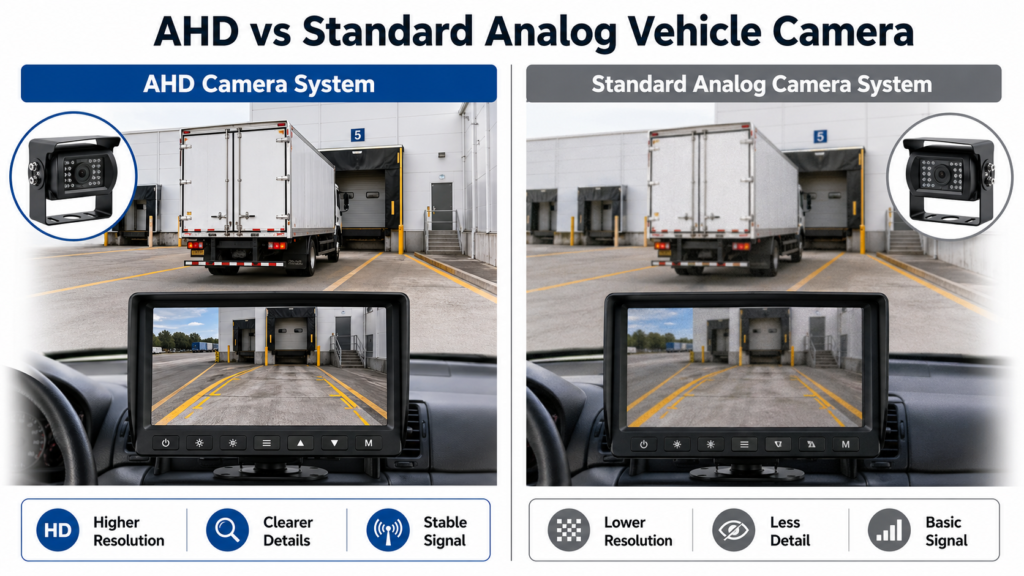
AHD Vehicle Camera vs Analog Camera: What Is the Difference?
For many commercial vehicle fleets, camera quality is not just a display issue. It affects driver visibility, blind spot management, accident prevention, maintenance costs, and system upgrade decisions.
Many older vehicles still use a standard analog vehicle camera system, often based on CVBS video signals. These systems are simple and cost-effective, but their image quality can be limited, especially when drivers need to identify pedestrians, loading dock edges, pallets, obstacles, or vehicles in low-light conditions.
An AHD vehicle camera offers a practical upgrade path. It provides higher-resolution video while still keeping many of the installation advantages of traditional analog systems. For fleet managers, OEM engineers, distributors, and installation companies, understanding the difference between AHD vs analog camera technology is important before selecting a new commercial vehicle camera system.
What Is an AHD Vehicle Camera?
An AHD vehicle camera is a camera that uses Analog High Definition video technology. AHD stands for Analog High Definition. It allows high-definition video signals to be transmitted over analog-style cables, usually with better image clarity than traditional CVBS analog cameras.
In commercial vehicle applications, AHD cameras are commonly used for:
- Rear-view camera systems
- Side-view blind spot cameras
- Front-view cameras
- Forklift camera systems
- Bus and coach monitoring systems
- Heavy-duty truck camera systems
- Construction and agricultural machinery monitoring
AHD technology is popular in B2B vehicle safety applications because it offers a balance between better image quality, reasonable cost, and easier system integration.
What Is a Standard Analog Vehicle Camera?
A standard analog vehicle camera usually refers to a CVBS camera. CVBS stands for Composite Video Baseband Signal. This is an older analog video format widely used in vehicle camera systems for many years.
Traditional analog cameras are still used because they are:
- Simple to install
- Low-cost
- Compatible with many older monitors
- Suitable for basic reversing applications
However, their main limitation is image resolution. In many commercial vehicle environments, standard analog video may not provide enough detail for modern safety requirements.
For example, when a driver needs to judge the distance between a forklift and a pallet rack, or when a truck driver needs to see a cyclist near the side blind spot, a low-resolution image can create real safety risk.
AHD vs Analog Camera: Key Differences
1. Image Resolution
The most important difference between an AHD vehicle camera and a standard analog camera is image resolution.
A traditional analog vehicle camera usually provides lower-definition video. It may be acceptable for basic reversing, but details can become unclear when the vehicle operates in rain, dust, low light, or strong sunlight.
An AHD camera can support higher resolutions such as:
- 720P AHD
- 1080P AHD
- In some systems, higher HD formats depending on monitor compatibility
For fleet safety, higher resolution helps drivers see:
- Pedestrians
- Loading dock edges
- Pallets and cargo
- Road markings
- Blind spot obstacles
- Construction site hazards
- Nearby vehicles or motorcycles
This makes AHD a better choice for a modern fleet safety camera system.
2. Monitor Compatibility
Before upgrading from analog to AHD, buyers must check vehicle camera monitor compatibility.
Not every monitor can display an AHD signal. Some older vehicle monitors only support CVBS input. If an AHD camera is connected to a monitor that only supports traditional analog video, the screen may show no image, unstable video, or incorrect color.
For B2B buyers, this is one of the most common mistakes during system upgrades.
Before purchasing an AHD camera, confirm:
- Does the monitor support AHD input?
- Does it support 720P or 1080P AHD?
- Does it also support CVBS for mixed systems?
- Are the camera and monitor using the same connector type?
- Is the system PAL/NTSC compatible if required?
- Does the monitor support trigger lines for reversing or side-view switching?
For distributors and installers, offering cameras and monitors as a matched system can reduce after-sales problems and warranty claims.
3. Signal Transmission
AHD cameras still use analog-style video transmission, which makes them easier to integrate into many existing commercial vehicle systems.
Compared with IP cameras, AHD systems usually do not require complex network configuration. Compared with traditional analog cameras, they offer clearer video.
This is why AHD is often selected for:
- Truck camera systems
- Bus surveillance systems
- Forklift camera systems
- Agricultural vehicle cameras
- Construction machinery monitoring
- Retrofit projects for older fleets
For many fleets, AHD provides a practical middle ground between old analog systems and more complex digital IP camera systems.
4. Low-Light and WDR Performance
Image clarity is not only about resolution. Commercial vehicles often operate in difficult lighting conditions.
Examples include:
- Trucks reversing at night
- Forklifts entering cold storage areas
- Buses stopping under strong sunlight
- Construction machines working in dusty environments
- Vehicles moving between indoor and outdoor areas
A high-quality AHD vehicle camera may include features such as:
- WDR for strong light contrast
- IR night vision
- Better CMOS sensor performance
- Anti-glare lens design
- Stable image processing
- Improved heat dissipation
A standard analog vehicle camera may still work in these conditions, but it often provides less detail and weaker contrast.
5. System Upgrade Cost
AHD is attractive for B2B buyers because it can improve image quality without requiring a full IP-based system upgrade.
For example, if a fleet already has camera cable routing and monitor brackets installed, upgrading to an AHD-compatible camera and monitor may be more practical than replacing the whole system with a network-based solution.
This matters for:
- Fleet managers who want to control maintenance budgets
- Distributors who need a cost-effective product line
- OEM engineers who need stable integration
- Installers who want faster retrofit projects
AHD is not always the cheapest option, but it often provides a better balance between performance and cost.
Application Scenarios for AHD Vehicle Cameras
Logistics Trucks: Long Routes and Changing Weather
Logistics trucks often run for long hours across highways, loading zones, warehouses, and city roads. Drivers face rain, night driving, strong sunlight, and temperature changes.
A standard analog camera may be enough for basic reversing, but it may not provide enough detail for side blind spots or rear monitoring during complex maneuvers.
An AHD vehicle camera can help improve:
- Rear visibility during reversing
- Side blind spot awareness
- Loading dock safety
- Night driving assistance
- Driver confidence during tight turns
For fleet managers, clearer video can reduce accident risk and vehicle downtime.
Forklifts: Cold Storage, Warehouses, and Blind Spots
Forklifts work in tight spaces where visibility is limited. In cold storage areas, cameras may face condensation, temperature changes, and humidity. In warehouses, drivers must avoid racks, pallets, workers, and other equipment.
A forklift camera system using AHD technology can help drivers see:
- Fork tips
- Pallet positions
- Rear blind spots
- Pedestrian zones
- Rack clearance
For safety officers, this can support safer warehouse operation and reduce collision risks. For distributors, forklift camera systems are also a strong niche product because buyers usually care about practical visibility, not just camera price.
Heavy Machinery: Dust, Vibration, and Harsh Environments
Heavy machinery used in construction, mining, agriculture, and industrial sites needs more than basic video. The camera must survive dust, vibration, mud, water spray, and shock.
For these applications, AHD technology should be combined with heavy-duty design features such as:
- IP67 or IP69K waterproof housing
- Vibration-resistant structure
- Shockproof mounting
- Sealed connectors
- Wide voltage input
- Stable heat dissipation
- Strong metal housing
In heavy-duty environments, image quality and durability must work together. A clear camera image is not useful if the housing, connector, or cable fails after repeated vibration.
Technical Buying Considerations for B2B Buyers
Check the Camera Resolution
Do not only ask whether the camera is “HD.” Confirm the actual signal format and resolution.
Useful questions include:
- Is it AHD 720P or AHD 1080P?
- Is it compatible with CVBS?
- What CMOS sensor is used?
- Does it support PAL and NTSC?
- Is the image stable under vibration?
Confirm Vehicle Camera Monitor Compatibility
Compatibility is one of the most important points in any commercial vehicle camera system.
Before ordering, confirm:
- Camera signal type: AHD, CVBS, or both
- Monitor input type
- Number of camera channels
- Connector type: aviation connector, RCA, M12, or customized cable
- Trigger function support
- Power input range
- Split-screen display function
- Recording or DVR compatibility if required
For distributors, this step helps reduce customer complaints after installation.
Evaluate Waterproof and Vibration Resistance
For trucks, forklifts, buses, and heavy machinery, camera durability matters as much as image quality.
A good B2B-grade camera should consider:
- IP67 or IP69K waterproof rating
- Anti-fog lens design
- Sealed housing
- Durable cable exit design
- Vibration-resistant bracket
- Wide operating temperature range
- Stable performance under long working hours
If the camera is used outside the vehicle, waterproofing and connector quality are especially important.
Consider WDR and Night Vision
Many vehicle accidents happen when visibility is poor. A camera with better low-light performance can make the system more useful in real operation.
Important features include:
- WDR for bright and dark contrast
- IR LEDs for night vision
- Low-light CMOS sensor
- Anti-glare lens
- Stable image processing
For logistics trucks and buses, WDR is especially valuable when vehicles move between tunnels, parking areas, loading docks, and open roads.
Buyer Checklist: How to Choose Between AHD and Analog Cameras
Before choosing between an AHD vehicle camera and a standard analog vehicle camera, B2B buyers should review the following checklist.
For Fleet Managers
- Do drivers need clearer side or rear visibility?
- Are current camera images too blurry at night?
- Are blind spot incidents increasing?
- Is vehicle downtime caused by camera or cable failure?
- Do existing monitors support AHD input?
- Is the fleet planning a gradual upgrade?
For OEM Engineers
- What video signal does the vehicle display platform support?
- Is AHD 720P or 1080P required?
- What is the operating voltage range?
- What are the vibration and temperature requirements?
- Is IP67 or IP69K needed?
- Are customized connectors or cable lengths required?
For B2B Distributors
- Can the camera work with existing monitors in the market?
- Is there a clear selling point compared with low-cost analog cameras?
- What is the expected defect rate?
- Is the warranty policy suitable for fleet customers?
- Are product images, specs, and installation guides available?
- Can the supplier provide stable repeat orders?
For Safety Officers
- Does the camera improve blind spot visibility?
- Can the system support safer reversing and turning?
- Is image quality good enough for incident review?
- Does the system reduce accident risk in high-traffic work zones?
- Can the camera work reliably in rain, dust, cold storage, or vibration?
When Should You Choose an AHD Vehicle Camera?
You should choose an AHD vehicle camera when your application requires clearer images than standard analog systems but does not need a full IP camera solution.
AHD is a strong choice when:
- Your fleet needs better visibility
- Your vehicles operate in harsh environments
- You want to upgrade from old analog cameras
- You need cost-effective HD video
- Your monitor supports AHD input
- You need a practical solution for trucks, forklifts, buses, or heavy machinery
For many commercial vehicle applications, AHD is not only a camera upgrade. It is a practical step toward safer and more reliable vehicle monitoring.
Product Recommendation: AHD Camera Solution from Xinvisual Electronics
For B2B buyers looking for a reliable AHD camera solution, [Insert Specific Model/SKU] can be positioned as a strong option for commercial vehicle applications.
It is suitable for:
- Logistics trucks
- Forklifts
- Buses
- Agricultural vehicles
- Construction machinery
- Fleet safety camera systems
- Vehicle monitor upgrade projects
Recommended product features to highlight:
- AHD high-definition video output
- Heavy-duty vehicle camera housing
- IP67 or IP69K waterproof design, depending on model
- Wide voltage compatibility
- Stable connection with compatible vehicle monitors
- Optional night vision and WDR support
- Suitable for rear, side, or front-view installation
For fleet operators, this helps improve driver visibility.
For OEM engineers, it supports practical system integration.
For distributors, it provides a clear upgrade product compared with standard analog cameras.
CTA:
Looking for an AHD vehicle camera for your next fleet, OEM, or distribution project? Contact Xinvisual Electronics to request a sample, download the spec sheet, or consult our engineering team for camera and monitor compatibility.
FAQ
Q1: What is the difference between an AHD vehicle camera and an analog vehicle camera?
An AHD vehicle camera provides higher-definition video than a standard analog vehicle camera while still using analog-style signal transmission. This makes it suitable for commercial vehicles that need clearer rear, side, or front visibility without moving to a full IP camera system.
Q2: Can an AHD vehicle camera work with a normal analog monitor?
An AHD vehicle camera can only work with a normal analog monitor if the monitor supports AHD input or dual AHD/CVBS compatibility. If the monitor only supports standard CVBS analog video, the image may not display correctly or may not appear at all.
Q3: Is AHD better than analog for fleet safety camera systems?
AHD is usually better than standard analog for fleet safety camera systems because it provides clearer images, better detail, and improved visibility for blind spots, reversing, and low-light operation. However, the camera, monitor, cable, and connector must be compatible as a complete system.
Q4: Should distributors sell AHD cameras instead of standard analog cameras?
Distributors should offer AHD cameras when their customers need better image quality, clearer selling points, and upgrade options for commercial vehicle monitoring systems. Standard analog cameras can still serve price-sensitive basic reversing applications, but AHD offers stronger value for professional fleet and safety projects.