

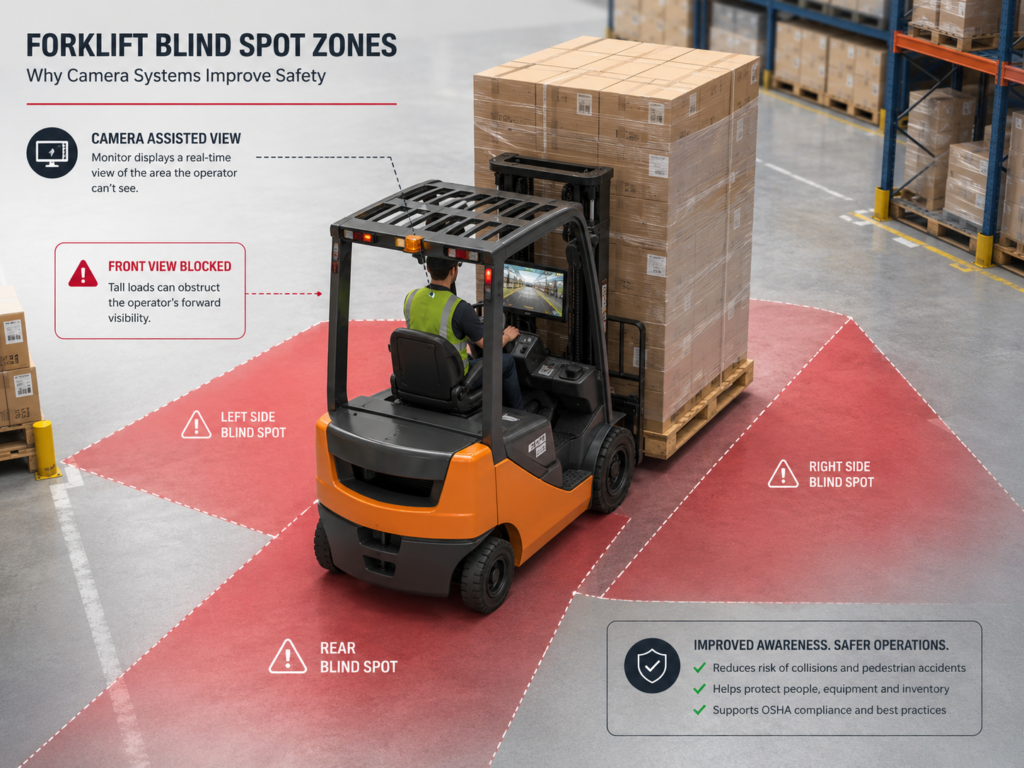
Why Forklift Accidents Often Happen in Blind Moments
Forklift accidents rarely happen because an operator cannot drive. In many cases, they happen during a short blind moment — a few seconds when the driver cannot clearly see a pedestrian, pallet, rack, loading dock edge, or another vehicle.
For warehouses, factories, cold storage facilities, logistics centers, and industrial sites, these blind moments can lead to serious consequences: damaged goods, injured workers, vehicle downtime, insurance claims, and expensive safety investigations.
A well-designed forklift blind spot camera system helps reduce these risks by improving forklift operator visibility in the areas where mirrors and direct sight are not enough.
Quick Answer
A forklift blind spot camera system helps operators see areas that are difficult to monitor directly, including rear blind spots, fork-level pallet zones, side blind areas and pedestrian movement around warehouse aisles.
For most warehouse safety projects, a practical configuration includes a wireless forklift camera, an in-cab monitor and, for high-risk areas, an AI pedestrian detection monitor or warning alarm function.
This type of system does not replace safe operation procedures, but it can give operators better real-time visibility and support accident reduction programs in busy material handling environments.
What Is a Blind Moment in Forklift Operation?
A blind moment is a short period when the forklift operator loses a clear view of a critical area around the vehicle.
This often happens when:
- A pallet blocks the forward view
- The forklift reverses in a narrow aisle
- The mast blocks part of the operator’s vision
- The operator turns near racks or pedestrians
- The forklift exits a trailer or container
- The vehicle operates in cold storage with condensation or poor lighting
- Dust, vibration, or mud affects visibility in industrial environments
In these situations, the operator may still be experienced and careful. The problem is not only human error. It is a visibility limitation.
That is why a forklift camera system is becoming an important safety upgrade for many warehouses and fleet applications.
Root Causes of Forklift Accidents in Blind Moments
1. Pallets and Loads Block the Operator’s View
One of the most common causes of warehouse forklift accidents is blocked forward visibility.
When a forklift carries a large pallet, box, drum, or irregular cargo, the load can fully or partially block the driver’s line of sight. In some cases, the operator may drive slowly and carefully, but still cannot see what is directly ahead.
This is especially risky when:
- Moving high-stacked pallets
- Handling wide or oversized cargo
- Entering a narrow aisle
- Approaching a loading dock
- Operating near pedestrians
- Moving goods in busy warehouse zones
A front-view forklift safety camera can help the operator see what the load blocks.
2. Rear Blind Spots During Reversing
Forklifts often reverse during daily operation. Unlike passenger vehicles, forklifts have compact structures, rear counterweights, masts, overhead guards, and limited sight angles.
A rear blind spot can be dangerous when the operator is backing up near:
- Workers
- Pallets
- Other forklifts
- Racking systems
- Dock doors
- Containers
- Warehouse walls
A forklift rear view camera gives the operator a clearer view behind the forklift, especially when reversing frequently in tight spaces.
For safety officers, this is one of the most practical ways to reduce collision risks in material handling areas.
3. The Mast Creates Structural Blind Zones
Forklift masts are necessary for lifting loads, but they also create visual blind zones. The higher and wider the mast structure, the more it can interfere with the operator’s field of view.
This problem becomes more serious when the forklift is used for:
- High rack stacking
- Cold storage handling
- Container loading
- Factory line material transfer
- Outdoor industrial yards
Mirrors can help in some cases, but they do not always provide enough detail. A camera mounted in the right position can give the operator a more direct and useful view.
4. Pedestrians Move Faster Than Operators Expect
Many forklift accidents happen because pedestrians enter a blind area at the wrong moment.
In busy warehouses, workers may move between aisles, loading zones, and packing areas. Even when safety lines are marked on the floor, real working conditions can be unpredictable.
Common risk points include:
- Cross-aisle intersections
- Loading dock entrances
- Warehouse corners
- Trailer loading areas
- Picking and packing zones
- Cold storage doors
A forklift blind spot camera system cannot replace safety procedures, but it can give the operator extra visibility during critical movements.
5. Lighting, Dust, and Condensation Reduce Visibility
Visibility is not only affected by the forklift structure. The working environment also matters.
Poor visibility can be caused by:
- Low warehouse lighting
- Strong backlight near dock doors
- Dust in construction or industrial yards
- Condensation in cold storage
- Rain or water spray in outdoor areas
- Dirty camera lenses
- Vibration during operation
For these conditions, camera quality matters. A basic low-cost camera may not be enough. Buyers should consider WDR, waterproof housing, vibration resistance, stable connectors, and suitable monitor brightness.
Application Scenarios: Where Blind Moments Become Dangerous
Logistics Trucks and Loading Docks
Forklifts often work around logistics trucks, trailers, and loading docks. These areas are busy, noisy, and full of short movement cycles.
Blind moments happen when a forklift:
- Enters or exits a trailer
- Moves between dock doors
- Reverses near a truck
- Handles pallets around dock plates
- Turns in a narrow loading area
A forklift camera system can help operators see the rear, front, or side areas more clearly during loading and unloading.
For logistics companies, this supports lower accident risk, less cargo damage, and smoother daily operation.
Forklifts in Cold Storage Warehouses
Cold storage creates special challenges for visibility.
Temperature differences can cause condensation. Doors may open and close frequently. Lighting can be limited. Operators often move in narrow spaces with high racks and frozen goods.
In this environment, forklift operator visibility can be reduced quickly.
A suitable forklift safety camera should consider:
- Anti-fog design
- Wide operating temperature range
- Stable cable connection
- Monitor brightness
- Durable camera housing
- Good low-light performance
For cold chain logistics, visibility is directly connected to safety and operating efficiency.
Heavy Machinery and Industrial Material Handling
Forklifts used in factories, ports, construction sites, and heavy industrial yards face more vibration, dust, and impact than normal warehouse forklifts.
In these environments, a camera system must be more durable.
Important features include:
- IP67 or IP69K waterproof protection
- Shock-resistant housing
- Vibration-resistant bracket
- Sealed connectors
- Wide voltage input
- Stable image transmission
- Strong metal camera body
- Reliable heat dissipation
A forklift blind spot camera system used in these conditions should be designed as an industrial safety product, not a simple consumer camera.
Technical Solutions to Reduce Forklift Blind Moments
1. Install the Right Camera in the Right Position
Camera position is one of the most important parts of the system.
Common forklift camera positions include:
- Front-view camera: helps when the load blocks forward visibility
- Rear-view camera: improves reversing safety
- Side-view camera: helps near aisles, racks, and pedestrians
- Fork arm camera: helps the operator align forks with pallets
- Overhead or mast camera: supports high stacking visibility
A good camera position should solve a real visibility problem. It should not be installed only because it looks convenient.
2. Use a Monitor That Supports Fast Driver Decisions
A camera is only useful if the operator can see the image clearly and quickly.
A suitable forklift monitor should offer:
- Clear screen resolution
- Good brightness
- Stable signal input
- Split-screen display if using multiple cameras
- Trigger function for reverse or side view
- Strong mounting bracket
- Wide voltage input
- Compact size for cab installation
For many forklift applications, a 7-inch or 10.1-inch monitor is practical, depending on cab space and the number of camera channels.
3. Choose Durable Camera Housing and Connectors
Forklifts face vibration, impact, dust, and frequent movement. Weak connectors and light-duty housings can cause image loss or after-sales problems.
For buyers, the camera should be evaluated as a complete system:
- Camera housing
- Lens protection
- Cable exit design
- Connector sealing
- Bracket strength
- Monitor compatibility
- Power input stability
- Installation environment
For outdoor forklifts, washdown areas, ports, and dusty industrial sites, IP69K waterproof protection can be a strong advantage.
4. Match the Camera Signal with the Monitor
Compatibility is critical.
Before ordering a forklift camera system, buyers should confirm:
- Is the camera AHD or CVBS?
- Does the monitor support the same signal format?
- Is the system PAL/NTSC compatible?
- Is the cable length suitable?
- Is the connector type correct?
- Does the monitor support multiple camera inputs?
- Is a DVR or recording function required?
Many installation problems are caused by mismatched camera and monitor specifications, not by the camera itself.
5. Consider WDR, Night Vision, and Anti-Fog Performance
Forklifts often work in difficult lighting conditions. A basic camera may show an image, but not enough useful detail.
Helpful features include:
- WDR: improves visibility when bright and dark areas appear together
- IR night vision: helps in low-light warehouses or outdoor yards
- Hydrophobic coating: helps reduce water impact on the lens
- Anti-fog design: useful for cold storage and temperature changes
- CMOS sensor quality: affects image clarity and low-light performance
- Stable heat dissipation: supports long working hours
For safety-focused buyers, image quality should be judged by real working conditions, not only by catalog resolution.
Recommended Configurations for Different Forklift Safety Needs
Rear Blind Spot Monitoring
Recommended setup: wireless rear camera, compact in-cab monitor, stable power connection or rechargeable battery option.
Best for: reversing, loading docks, warehouse aisles and areas where pedestrians or vehicles may appear behind the forklift.
Fork View and Pallet Handling
Recommended setup: front or fork-mounted camera, clear monitor display and adjustable mounting position.
Best for: pallet positioning, rack operation and applications where the operator needs a better view of fork tips or load placement.
Pedestrian Safety Monitoring
Recommended setup: AI detection camera or AI monitor, warning alarm function and multi-camera option for wider coverage.
Best for: warehouses where forklifts and pedestrians work in the same area, especially intersections, blind corners and loading zones.
Fleet Retrofit Projects
Recommended setup: wireless camera system, magnetic mounting option and OEM / ODM configuration support.
Best for: existing forklift fleets, rental forklifts and projects where quick installation is required.
Buyer Checklist for Forklift Camera System Selection
For Fleet Managers
- Which accident risks happen most often: reversing, turning, loading, or stacking?
- Are current mirrors enough for the operator?
- How many forklifts need camera upgrades?
- Is downtime caused by damaged cameras or cables?
- Does the system reduce maintenance and safety incidents?
- Is the supplier able to provide stable repeat orders?
For OEM Engineers
- What voltage range is required?
- Does the monitor support AHD or CVBS?
- What camera mounting position is needed?
- Is the forklift used indoors, outdoors, or in cold storage?
- What IP rating is required?
- What vibration and temperature range should the system meet?
- Are customized cables or connectors needed?
For B2B Distributors
- Does the product have clear selling points?
- Is the system easy for installers to understand?
- Can the supplier provide product images, specs, and installation guidance?
- Are camera and monitor compatibility clearly defined?
- What is the warranty policy?
- Can the system be sold as a complete forklift safety kit?
For Safety Officers
- Which blind spots create the highest accident risk?
- Are pedestrians frequently working near forklifts?
- Are loading docks, cross aisles, and cold storage doors high-risk areas?
- Can camera visibility support safer daily operation?
- Does the system help reduce collision and insurance risk?
- Is the operator trained to use the monitor correctly?
Product Recommendation: Forklift Camera System from Xinvisual Electronics
For warehouses, logistics fleets, cold storage facilities, and industrial material handling applications, a reliable forklift blind spot camera system can help reduce risk in the short moments when operators cannot see clearly.
Xinvisual Electronics provides vehicle cameras, vehicle monitors, and forklift camera systems. For this topic, the recommended solution can be positioned as:
This system can be configured for:
- Rear-view monitoring
- Front-view monitoring
- Side blind spot monitoring
- Fork arm camera visibility
- Cold storage operation
- Warehouse forklift safety
- Heavy-duty industrial applications
Key product points to highlight:
- Durable vehicle camera design
- Optional AHD high-definition image
- Compatible vehicle monitor options
- IP69K waterproof
- Stable cable and connector design
- Wide voltage input
- Optional night vision or WDR support
- Suitable for B2B fleet, warehouse, and distributor projects
CTA:
Need a forklift camera system for warehouse safety, fleet upgrade, or distribution? Contact Xinvisual Electronics to request a sample, download the spec sheet, or consult our engineering team for the right camera and monitor configuration.
Need Help Choosing a Forklift Camera System?
Xinvisual Electronics supplies forklift cameras, wireless camera systems, AI detection monitors and vehicle display solutions for warehouse safety projects, distributors and OEM customers.
If you are planning a forklift safety upgrade, our team can recommend a camera configuration based on your forklift model, warehouse layout, mounting position and detection requirement.
Request a Warehouse Forklift Safety Solution
Related Forklift Safety Solutions
Explore Xinvisual solutions for forklift visibility and warehouse accident reduction:
- Forklift Safety Camera Solution
- Wireless Forklift Camera
- 1080p Wireless Forklift Camera
- BSD AI Camera
- 10.1 Inch BSD AI Vehicle Monitor
- Wireless Camera System
FAQ
Q1: Why do forklift accidents often happen in blind moments?
Forklift accidents often happen in blind moments because the operator temporarily loses a clear view of pedestrians, pallets, racks, dock edges, or nearby vehicles. These short visibility gaps can occur during reversing, turning, loading, stacking, or moving with a large pallet that blocks the driver’s sight.
Q2: How does a forklift blind spot camera system improve safety?
A forklift blind spot camera system improves safety by giving the operator a clearer view of areas that mirrors or direct sight cannot fully cover. It helps during reversing, loading, turning, pallet handling, and warehouse movement where pedestrians, racks, or other equipment may enter blind zones.
Q3: What camera positions are most useful on a forklift?
The most useful forklift camera positions are rear-view, front-view, side-view, and fork arm camera locations. Rear cameras help with reversing, front cameras help when loads block visibility, side cameras support aisle movement, and fork arm cameras improve pallet alignment during lifting and stacking.
Q4: What should B2B buyers check before ordering a forklift camera system?
B2B buyers should check camera signal format, monitor compatibility, voltage range, connector type, cable length, IP rating, vibration resistance, operating temperature, and installation position before ordering. A forklift camera system works best when the camera, monitor, cable, and mounting design are matched as one complete solution.
Q5: What is the best camera position for forklift blind spot monitoring?
The best position depends on the visibility problem. Rear-mounted cameras are commonly used for reversing, front or fork-mounted cameras help with pallet handling, and side cameras can support narrow aisle visibility.
Q6: Should I choose a wired or wireless forklift camera system?
A wireless system is often easier for retrofit installation because it reduces cable routing work. A wired system may be preferred for some permanent installations where cable protection and routing are already planned.
Q7: Can AI detection be added to a forklift camera system?
Yes. For higher-risk warehouse areas, AI pedestrian detection monitors or AI cameras can be added to support operator awareness. The system should be described as a safety support component, not as a replacement for safe operating procedures.
Q8: Is a forklift camera system suitable for outdoor forklifts?
Yes, but outdoor forklifts should use cameras with suitable waterproof and vibration-resistant housing. For harsh environments, IP69K camera options and larger monitor displays may be recommended.