

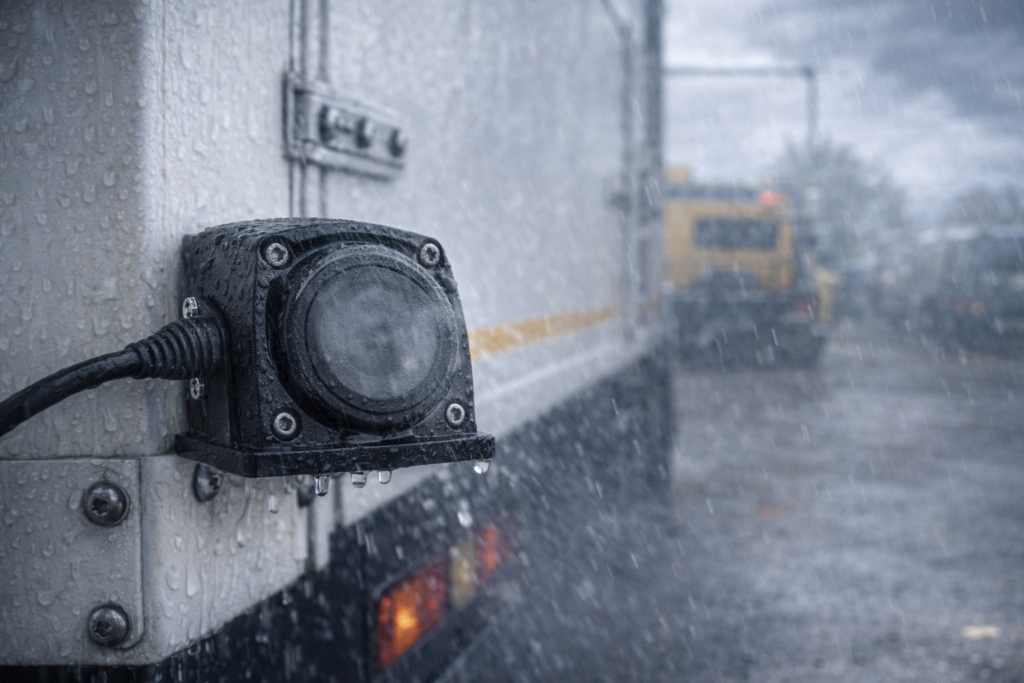
Why Waterproof Vehicle Cameras Still Fog Up — And What Buyers Should Really Check
Internal fogging in a vehicle camera may seem like a minor issue at first. But in real commercial vehicle use, it can quickly become a safety risk, a maintenance problem, and an after-sales headache.
For fleet operators, installers, and distributors, durability is one of the most important factors when choosing a vehicle camera. Many buyers specifically look for IP69K-rated cameras because they are expected to work in rain, mud, wash bays, and other harsh environments.
However, one issue still appears more often than expected: the lens fogs up from the inside.
This often happens after heavy rain, high-pressure washing, or sudden temperature changes. Once condensation forms inside the camera, the image becomes unclear, visibility is reduced, blind spots increase, and confidence in the whole system drops.
So why does this happen if the camera is supposed to be waterproof?
1. Why internal fogging happens
When people first notice condensation inside a camera, the natural reaction is:
“Water must be getting in somewhere.”
Sometimes that is true, but not always.
A common reason for internal fogging is pressure difference caused by temperature change.
During operation, the internal electronics generate heat, which warms the air trapped inside the camera housing. Then, when the vehicle suddenly moves into cold rain, snow, or a wash bay, the outer temperature drops rapidly. As the housing cools, internal pressure changes.
That pressure difference can draw humid outside air into the camera through microscopic weak points in the sealing system. Once that humid air reaches the colder inner side of the lens, condensation forms.
So in many cases, fogging is not caused by one obvious leak. It is the result of a gradual design weakness that only becomes visible under repeated real-world conditions.
2. What usually causes the problem
If a vehicle camera keeps fogging up, the reason is often linked to one or more of the following factors.
Aging or unstable sealing materials
Some cameras use lower-grade rubber or silicone seals that perform acceptably at the beginning, but lose elasticity over time. Under strong UV exposure, high summer temperatures, and daily vibration, these materials may harden, shrink, or crack.
Once the sealing material becomes unstable, the camera becomes much more vulnerable to pressure-related moisture entry.
Moisture entering through the cable path
This is one of the most overlooked details.
Moisture does not always enter through the front housing or lens area. In some cases, it travels along the cable path — inside the conductor area or between the inner core and the outer jacket — especially when connector sealing is not done properly.
Over time, this moisture can migrate toward the camera body and eventually create condensation inside the housing.
No pressure equalization design
Many low-cost cameras are sealed, but not intelligently sealed.
A housing with no pressure equalization is constantly exposed to expansion and contraction caused by temperature cycles. This repeated thermal stress gradually weakens the sealing points, even if the unit passes a basic waterproof test at first.
That is why some cameras perform well in short-term lab testing, but begin fogging in the field after weeks or months of use.
3. What buyers should really look for
If fogging has become a repeated issue in your projects, the solution is usually not just choosing a product with a higher IP rating. A better approach is to look deeper into how the camera is actually designed.
Breather vents or pressure equalization valves
Higher-grade vehicle cameras often include a hydrophobic vent or breather membrane. This allows air pressure to equalize while still blocking water, dust, and contaminants.
In practical terms, the camera can “breathe” without letting moisture in. This is one of the most effective ways to reduce pressure-driven condensation.
Dry internal assembly or nitrogen-filled housing
Some premium cameras are assembled in controlled environments and filled with dry nitrogen before sealing. This removes humid air from inside the housing and reduces the chance of internal condensation when the camera experiences sudden temperature changes.
For demanding vehicle applications, this can make a meaningful difference in long-term reliability.
Automotive-grade potting and sealing
It is also worth checking whether the camera uses proper potting compounds and automotive-grade sealing materials. When the internal cavity is better protected and critical areas are reinforced, there is less room for air movement or moisture accumulation.
These details may not be obvious in product photos, but they often have a major impact on field performance.
4. Why this matters in real projects
In commercial vehicle applications, the real cost of a camera problem is usually not the hardware itself.
The bigger cost often comes from:
- repeated replacements
- installation labor
- vehicle downtime
- driver complaints
- safety risks caused by poor visibility
For distributors and installers, repeated fogging issues can also damage customer trust and increase after-sales workload. For fleet operators, even a small camera issue can create unnecessary maintenance pressure across multiple vehicles.
That is why waterproof performance should not be judged only by a line in the specification sheet. What really matters is whether the camera stays clear and stable after months of exposure to washing, vibration, weather, and temperature swings.
5. A better way to test camera samples
If you are evaluating camera samples, it is worth going beyond a simple water immersion test.
A more practical method is a thermal shock test.
For example:
- place the camera in a 50°C / 122°F environment for about one hour
- then move it immediately into ice-cold water
This kind of test creates the temperature stress that often reveals whether a camera is likely to fog up in real working conditions.
It is not the only test that matters, but it is often much closer to the reality of road use than a basic waterproof demonstration.
Conclusion
When a “waterproof” vehicle camera fogs up from the inside, the issue is often not just about water exposure. More often, it comes down to pressure balance, sealing design, cable protection, and long-term material stability.
For buyers, installers, and fleet operators, understanding these details can lead to better sourcing decisions, fewer replacements, and more reliable long-term performance.
In vehicle safety systems, many costly failures do not begin with dramatic damage. They begin with small design weaknesses that are ignored too early.
And in commercial vehicle applications, those small details usually become expensive later.
Need a More Reliable Vehicle Camera for Harsh Environments?
At xinvisual electronics, we focus on vehicle cameras and monitor systems designed for demanding commercial applications, including trucks, forklifts, buses, agricultural machinery, and construction equipment.
If you are testing new camera suppliers or looking to reduce after-sales issues caused by fogging, feel free to contact us for product details or sample evaluation support.
FAQ
1. Why does an IP69K vehicle camera still fog up inside?
Because IP rating alone does not guarantee long-term protection against pressure-driven moisture entry, poor cable sealing, or weak pressure equalization design.
2. Does internal fogging mean the camera is defective?
Not always at the beginning, but repeated fogging usually indicates a sealing weakness or structural design issue that may lead to reliability problems later.
3. How can buyers test whether a waterproof camera will fog up?
A thermal shock test is often more meaningful than a basic waterproof test because it better simulates real working conditions.