

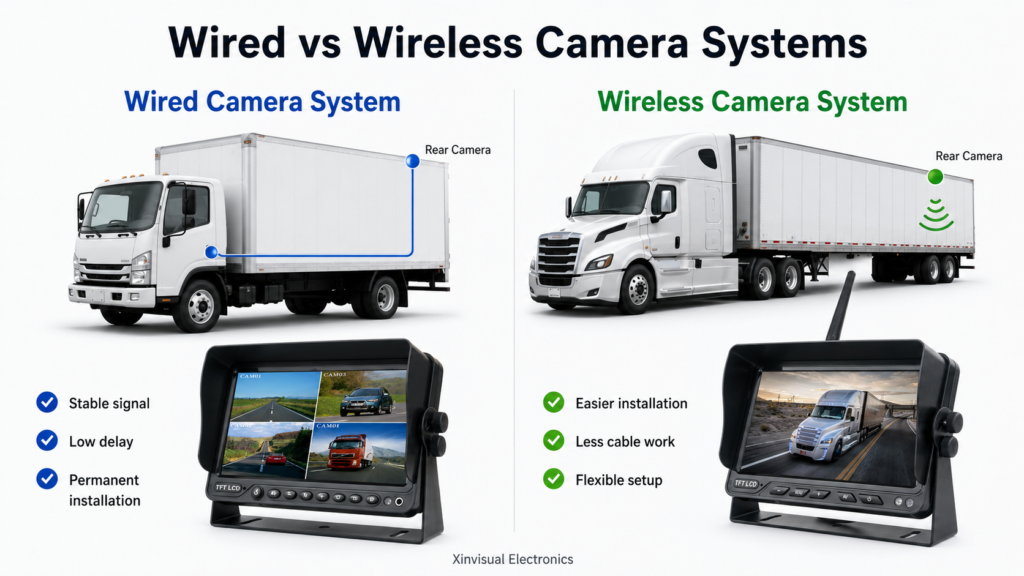
Wired vs Wireless Vehicle Camera Systems: How Buyers Should Choose for Trucks, Forklifts, and Trailers
For commercial vehicles, choosing between a wired and wireless camera system is not only about installation convenience.
It affects signal stability, driver visibility, maintenance cost, installation time, warranty risk, and long-term reliability.
A wired vs wireless vehicle camera system decision should always start with the vehicle type, working environment, installation distance, and safety purpose. A system that works well on a forklift may not be the best choice for a long trailer. A solution that is easy to install on a temporary setup may not be stable enough for a heavy-duty fleet project.
For B2B buyers, the real question is not:
“Which system is better?”
The better question is:
“Which system is better for this vehicle, this installation, and this working condition?”
What Is a Wired Vehicle Camera System?
A wired vehicle camera system connects the vehicle camera to the monitor through physical cables.
A typical wired system includes:
- Rear camera, side camera, or front camera
- Extension cable
- Waterproof connector or aviation connector
- In-cab monitor
- Power cable
- Trigger wire
- Bracket and mounting accessories
Wired systems are widely used on trucks, buses, construction vehicles, agricultural machinery, forklifts, and other commercial vehicles that need stable video transmission.
The main advantage is simple: the signal travels through a physical connection.
That makes a wired system a strong choice when stable video is more important than fast installation.
What Is a Wireless Vehicle Camera System?
A wireless vehicle camera system transmits video from the camera to the monitor without running a full video cable between them.
In most commercial vehicle applications, the camera still needs power. “Wireless” usually means wireless video transmission, not a completely cable-free camera.
A typical wireless system includes:
- Wireless rear camera or side camera
- Wireless transmitter
- Wireless receiver or built-in wireless monitor
- Power cable for camera
- Power cable for monitor
- Antenna or internal signal module
- Mounting accessories
Wireless systems are often considered when cable routing is difficult, expensive, temporary, or time-consuming.
They are commonly used for:
- Forklifts
- Trailers
- RVs
- Temporary fleet setups
- Vehicles where long wiring is difficult
- Applications where installation speed matters
Wired vs Wireless Vehicle Camera System: Key Differences
1. Signal Stability
Signal stability is one of the most important differences.
A wired vehicle camera system usually provides more stable video because the signal is transmitted through a cable. This is valuable for trucks, buses, heavy machinery, and permanent fleet installations.
A wireless vehicle camera system reduces cable work, but signal performance can be affected by distance, metal structures, interference, vehicle movement, or working environment.
For B2B buyers, this means:
- Choose wired when signal stability is the top priority
- Consider wireless when cable routing is the main challenge
- Test wireless transmission distance before bulk orders
- Avoid assuming all wireless systems perform the same in every environment
For safety-critical applications, a stable image is more important than a convenient installation.
2. Installation Time
Wireless systems can reduce installation time because installers do not need to run long video cables from the rear of the vehicle to the cab.
This is useful for:
- Trailers
- Forklifts
- Rental vehicles
- Temporary installations
- Vehicles with difficult cable routes
- Small fleet upgrades where downtime must be reduced
Wired systems usually require more installation work. Cables need to be routed, protected, fixed, and connected properly.
However, once installed correctly, a wired system can provide long-term stable operation with fewer signal-related concerns.
For installers and fleet service companies, the choice often depends on labor cost, project schedule, and maintenance expectations.
3. Maintenance and Troubleshooting
Wired systems and wireless systems have different maintenance points.
For wired systems, common maintenance checks include:
- Cable damage
- Connector sealing
- Loose aviation connector
- Water ingress
- Trigger wire connection
- Cable routing near sharp edges or moving parts
- Monitor input compatibility
For wireless systems, common maintenance checks include:
- Signal interference
- Transmitter and receiver pairing
- Power supply to camera
- Antenna position
- Transmission distance
- Metal obstruction
- Monitor wireless channel setting
Wired problems are often physical connection problems.
Wireless problems are often signal environment problems.
B2B buyers should train installers and maintenance teams based on the system type.
4. Image Delay
A wired system usually has very low delay because the signal travels directly through the cable.
This is important for:
- Reversing
- Tight-yard maneuvering
- Loading dock operation
- Forklift movement
- Heavy machinery operation
- Side blind spot monitoring
Wireless systems may have slight delay depending on the transmission technology, distance, interference, and system design.
For many general monitoring applications, a small delay may not be a major problem. But for safety-critical reversing or close-distance operation, image response should be tested carefully.
5. Vehicle Compatibility
A wired camera system is often easier to standardize for fleets with similar vehicle types.
For example, a fleet of trucks can use the same camera, monitor, cable length, connector type, and trigger wire design.
Wireless systems can be more flexible for vehicles where cable routing is not practical.
However, buyers should still confirm:
- Camera power supply
- Monitor compatibility
- Transmission distance
- Signal format
- Mounting location
- Weather protection
- Connector type
- Whether multiple wireless systems will operate nearby
For distributors, this is important because one customer may use the same product on trucks, forklifts, and trailers — but each vehicle may require a different configuration.
Application Scenario 1: Trucks
For trucks, a wired vehicle camera system is often the preferred choice for permanent installations.
Trucks usually need stable video for:
- Rear-view monitoring
- Side blind spot monitoring
- Front-view monitoring
- Reversing
- Lane change support
- Loading dock operation
- Urban delivery safety
A wired truck camera system can support long-term reliability when the cable routing is planned correctly.
Important points for truck projects include:
- Cable length from rear camera to cab
- Waterproof rear camera connector
- Side camera mounting position
- Monitor brightness
- AHD or CVBS compatibility
- Trigger wire for reverse or turn signal
- Cable protection along the chassis
- Wide voltage support for 12V / 24V vehicles
For heavy-duty trucks, construction trucks, municipal vehicles, and logistics fleets, wired systems usually provide a more stable foundation.
Wireless may still be used in some truck applications, especially when cable routing is difficult or when the vehicle configuration changes often. But for long-term fleet projects, wired is often easier to standardize and maintain.
Application Scenario 2: Forklifts
Forklifts have different challenges.
A forklift camera system is often used in warehouses, cold storage, factories, logistics yards, and material handling areas.
Forklifts may need cameras for:
- Rear-view visibility
- Front-view visibility when carrying tall pallets
- Fork-arm alignment
- Side blind spots
- Pedestrian awareness
- Loading dock safety
For forklifts, wireless systems can be attractive because cable routing may be difficult around the mast, body structure, or moving parts.
A wireless vehicle camera system can help reduce installation work when:
- The camera is mounted near the fork arm
- Wiring may be exposed to movement
- The installation needs to be quick
- The vehicle works in a warehouse environment
- The customer wants less cable routing
However, buyers should still check:
- Wireless signal stability inside warehouses
- Metal rack interference
- Cold storage conditions
- Camera power supply
- Vibration resistance
- Monitor mounting position
- Signal delay during operation
For some forklifts, a wired system may still be better, especially for permanent rear-view installation or when signal stability is critical.
The best choice depends on where the camera is installed and what visibility problem it is solving.
Application Scenario 3: Trailers
Trailers are one of the most common reasons buyers consider wireless camera systems.
Running a cable from the rear of a trailer to the cab can be difficult, especially when the trailer is detached, changed, or used with different tractors.
A trailer camera system may need to support:
- Rear visibility
- Reversing
- Docking
- Trailer coupling
- Long-distance signal transmission
- Quick installation
- Flexible tractor-trailer combinations
Wireless systems can reduce the need for long cable runs across the full trailer length.
But trailer projects require careful testing because wireless transmission may be affected by:
- Long distance
- Metal trailer body
- Signal obstruction
- Interference from other equipment
- Weather conditions
- Power availability at the camera location
For trailer applications, buyers should not choose wireless only because it sounds easier. They should test real transmission distance, camera power supply, and monitor reception inside the cab.
For permanent tractor-trailer systems where stable signal is the top priority, a wired solution with proper connectors and cable routing may still be the safer option.
When Wired Camera Systems Are the Better Choice
A wired camera system is usually better when:
- The vehicle is used for permanent fleet operation
- Signal stability is critical
- The camera image is used for reversing or blind spot safety
- The vehicle works in harsh outdoor environments
- The fleet wants standardized installation
- The system includes multiple cameras
- Long-term maintenance is more important than installation speed
- The vehicle is a truck, bus, construction machine, or agricultural machine
Wired systems are especially suitable for:
- Logistics trucks
- City buses
- Heavy-duty trucks
- Municipal vehicles
- Construction equipment
- Agricultural machinery
- Fixed fleet camera programs
The main challenge is installation work. But when the wiring is done properly, the system is usually stable and predictable.
When Wireless Camera Systems Are the Better Choice
A wireless system may be better when:
- Cable routing is difficult
- Installation time must be reduced
- The vehicle is temporary or frequently changed
- The camera is mounted on a trailer
- The camera is used on a forklift where wiring is inconvenient
- The customer wants less cable work
- The system is used in a controlled environment
- The buyer can test signal performance before bulk installation
Wireless systems are especially useful for:
- Trailers
- Forklifts
- RVs
- Temporary fleet setups
- Vehicles with moving sections
- Installations where long cables are not practical
The main challenge is signal environment. Buyers should test before making large-volume decisions.
Technical Buying Checklist for B2B Buyers
For Fleet Managers
- Which vehicles need camera systems?
- Is the system for permanent or temporary use?
- Is stable image quality more important than fast installation?
- Are drivers using the camera for safety-critical maneuvers?
- Will the vehicle operate in rain, dust, vibration, or cold storage?
- How much downtime is acceptable during installation?
- Can the fleet maintenance team service the system later?
For OEM Engineers
- Is the system integrated into a vehicle platform?
- Is wired video transmission required for stability?
- What signal format is needed: AHD, CVBS, or digital?
- What voltage range applies?
- Are customized connectors or cable lengths needed?
- What vibration and temperature range should the system meet?
- Is wireless transmission acceptable for the application?
- Does the monitor support the required input type?
For B2B Distributors
- Can you explain the difference between wired and wireless clearly?
- Which customer applications are most common in your market?
- Do customers need truck, forklift, or trailer systems?
- Can the supplier provide complete kits?
- Are cables, connectors, antennas, brackets, and monitors included?
- Are installation diagrams available?
- Can wireless distance be demonstrated?
- Is warranty risk higher for the wrong application?
For Installers
- Is there a safe cable routing path?
- Where will the camera be mounted?
- Where will the monitor be installed?
- Is the connector waterproof?
- Is the cable protected from sharp edges?
- Will the wireless signal pass through metal structures?
- Does the camera need a separate power supply?
- Has the system been tested after installation?
Common Mistakes to Avoid
Mistake 1: Choosing Wireless Only to Save Installation Time
Wireless systems can reduce cable work, but they are not automatically better for every commercial vehicle.
If the application requires stable, low-delay video in harsh conditions, a wired system may still be the better choice.
Mistake 2: Ignoring Power Supply
Wireless does not always mean no wiring.
Most wireless cameras still need power. If there is no reliable power source near the camera mounting position, installation may still be difficult.
Mistake 3: Using Wired Systems Without Protecting Cables
Wired systems can be very stable, but poor cable routing can create problems.
Cables should be protected from:
- Sharp edges
- Moving parts
- Heat
- Water collection areas
- Chassis vibration
- Excessive pulling
- Door or tailgate pinch points
Mistake 4: Not Testing Wireless Signal in the Real Vehicle Environment
A wireless system may work well in a test room but behave differently on a long trailer, inside a warehouse, or near metal structures.
Always test:
- Real vehicle distance
- Cab reception
- Antenna position
- Interference
- Video delay
- Image stability
- Multi-vehicle operation if several systems work nearby
Mistake 5: Selling One System for Every Vehicle Type
Trucks, forklifts, and trailers have different installation challenges.
A professional B2B supplier should help buyers match the system to the application, instead of recommending the same kit for every vehicle.
Practical Selection Guide
Choose Wired If:
- The vehicle is a truck, bus, or heavy-duty machine
- The system is permanent
- Stable video is the top priority
- The vehicle has long daily operating hours
- The customer wants lower signal risk
- Multiple cameras are required
- The installation team can route cables properly
Choose Wireless If:
- Cable routing is too difficult
- The vehicle is a trailer, forklift, or temporary setup
- Installation speed is important
- The environment allows stable signal transmission
- The system has been tested at the required distance
- The camera has a reliable power source
- The buyer accepts possible signal-environment limitations
Consider a Mixed System If:
Some projects may use both wired and wireless solutions.
For example:
- Wired cameras for truck front and side view
- Wireless rear camera for trailer
- Wired monitor in cab
- Wireless transmission for detachable equipment
- Wired system for permanent camera positions
- Wireless system for temporary or hard-to-wire camera positions
A mixed system can be practical when the vehicle application is complex.
How Xinvisual Electronics Supports Wired and Wireless Vehicle Camera Projects
At Xinvisual Electronics, we provide vehicle cameras, vehicle monitors, wireless camera systems, wired camera system kits, forklift camera systems, and accessories for B2B commercial vehicle applications.
Our solutions can support:
- Wired vehicle camera systems for trucks, buses, forklifts, construction equipment, agricultural machinery, and fleet projects
- Wireless vehicle camera systems for trailers, forklifts, RVs, temporary setups, and vehicles where cable routing is difficult
- AHD and CVBS camera options
- Multi-channel vehicle monitors
- Trigger wire functions for reverse, side, or turn signal views
- Waterproof connectors and aviation connectors
- Wide voltage monitor options
- Custom cable lengths and system matching support
For buyers who are not sure which system is suitable, we usually recommend starting with the application:
- Vehicle type
- Camera position
- Installation distance
- Working environment
- Signal stability requirement
- Monitor size
- Wired or wireless preference
- Expected order volume
A good system is not just about choosing wired or wireless. It is about making sure the full camera, monitor, cable, connector, and installation plan work together.
Conclusion
There is no single answer to the wired vs wireless question.
A wired vehicle camera system is usually better for permanent fleet installations where stable signal, low delay, and long-term reliability are the priority.
A wireless vehicle camera system is often useful when cable routing is difficult, installation time must be reduced, or the system is used on trailers, forklifts, or temporary vehicle setups.
For B2B buyers, the best choice depends on the vehicle, the camera position, the working environment, and the safety purpose.
Before choosing a system, ask:
Where is the camera installed?
How far is the monitor from the camera?
Is the vehicle permanent or detachable?
Is signal stability more important than installation speed?
Will the system operate in metal-heavy, wet, dusty, or high-vibration environments?
When these questions are clear, the right system choice becomes much easier.
Need help choosing between wired and wireless vehicle camera systems?
Contact Xinvisual Electronics to discuss your truck, forklift, trailer, or fleet project.
We can help you review camera position, monitor compatibility, cable routing, wireless distance, connector type, and system configuration.
Request a sample, ask for a B2B quotation, or consult our team for a suitable vehicle camera system.
FAQ
Q1: Is a wired vehicle camera system better than a wireless system?
A wired vehicle camera system is usually better when signal stability, low delay, and long-term reliability are the top priorities. It is commonly preferred for trucks, buses, heavy-duty vehicles, and permanent fleet installations where camera images are used for reversing, side visibility, or safety-critical operation.
Q2: When should B2B buyers choose a wireless vehicle camera system?
B2B buyers should choose a wireless vehicle camera system when cable routing is difficult, installation time must be reduced, or the application involves trailers, forklifts, RVs, or temporary vehicle setups. However, wireless distance, interference, power supply, and real working conditions should be tested before bulk installation.
Q3: Are wireless vehicle cameras completely cable-free?
Wireless vehicle cameras are usually not completely cable-free because the camera still needs a power supply. In most commercial vehicle systems, “wireless” means the video signal is transmitted wirelessly between the camera and monitor, while the camera and monitor still require power connections.
Q4: Which camera system is better for trailers?
Wireless camera systems are often considered for trailers because long cable routing from the trailer rear to the cab can be difficult, especially when trailers are detached or exchanged. However, for safety-critical or long-distance applications, buyers should test wireless signal stability or consider a wired solution.