

Camera-Based BSD vs Radar-Based BSD: A Buyer Guide for Commercial Vehicle Projects
Blind spot detection is becoming a common requirement in truck, bus, forklift, construction vehicle, and municipal fleet projects.
However, buyers often compare camera-based and radar-based BSD systems as if they perform the same job.
They do not.
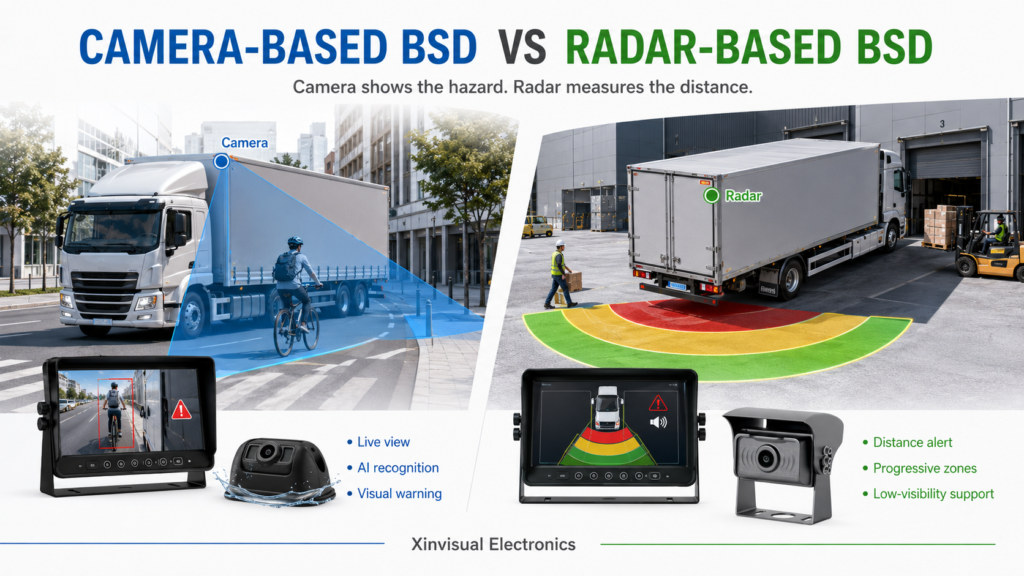
A camera-based BSD system gives the driver a visual image of the blind spot. When AI recognition is included, it may also identify pedestrians or vehicles and generate visual and audible warnings.
A radar blind spot detection system detects objects through radar signals and can provide distance-related alarms even when the driver is not looking directly at a camera image.
For commercial vehicle projects, the right choice depends on what information the driver needs:
- Visual confirmation
- Object recognition
- Distance warning
- Low-light performance
- Environmental resistance
- Integration with the monitor
- Installation position
- False-alarm control
This guide explains how B2B buyers should evaluate camera-based BSD vs radar BSD before selecting a system.
What Is Camera-Based Blind Spot Detection?
A camera-based blind spot detection system uses one or more cameras to show areas that the driver cannot see directly.
A standard side or rear camera provides a live video image. An AI blind spot detection camera adds image recognition and warning functions.
Depending on the configuration, an AI camera may identify:
- Pedestrians
- Cyclists
- Vehicles
- Objects entering a defined detection area
When a target enters the configured warning zone, the system may display a danger symbol on the monitor and generate an audible alert.
The main advantage is that the driver can see what created the warning.
AI Camera Functions and Specifications
Based on the supplied Xinvisual product documentation, our AI waterproof camera supports:
- Automatic pedestrian and vehicle recognition
- AI recognition reminders and early warnings
- Audible alarms
- On-screen danger symbols
- AHD 720P/1080P video output
- Infrared night vision
- Five infrared LEDs
- Optional 130° or 150° viewing angle
- Aluminum-alloy housing
- IP69K waterproof protection
Actual detection performance depends on installation height, camera angle, target size, vehicle speed, configured detection zone, and environmental conditions.
What Is Radar-Based Blind Spot Detection?
A radar-based BSD system uses radio waves to detect objects within a defined area.
Instead of showing only a video image, radar measures information such as:
- Object distance
- Relative movement
- Detection direction
- Entry into predefined alarm zones
Radar is useful when the buyer needs an automatic warning based on object position or distance.
The driver may receive:
- Visual alarm layers on the monitor
- Audible warnings
- Distance-related alerts
- Alarm escalation as the object moves closer
Unlike a camera, radar does not normally give the driver visual confirmation of what the object is. This is why radar is often paired with a camera and monitor.
Radar Functions and Specifications
- Working frequency: 24.00–24.25 GHz
- FMCW transmission
- Refresh cycle: 50 ms
- Detection distance: up to 10 m
- Distance resolution: 0.77 m
- Distance accuracy: 0.15–0.3 m
- Horizontal antenna beam: ±120°
- Vertical antenna beam: ±50°
- Listed horizontal angle: 150°
- Power input: DC 12V
In reverse operation, Xinvisual’s radar monitor can display three alarm layers:
- Green zone: approximately 6–4.5 m
- Yellow zone: approximately 4.5–2 m
- Red zone: approximately 2–0 m
The system also supports two-level audible warning and radar alarms.
These features are useful when the buyer needs progressive distance warning rather than video alone.
Camera-Based BSD vs Radar BSD: Main Differences
| Comparison Point | Camera-Based BSD | Radar-Based BSD |
|---|---|---|
| Information provided | Live visual image | Object presence and distance |
| Object identification | AI models may distinguish pedestrians and vehicles | Usually detects objects without visual classification |
| Driver confirmation | Driver can see the hazard | Driver receives an alert but may not see the object |
| Distance measurement | Usually estimated visually unless combined with other technologies | Supports measured distance and alarm zones |
| Night operation | Depends on sensor, IR, illumination, and lens condition | Does not depend on visible light in the same way |
| Weather influence | Lens may be affected by dirt, water, fog, or glare | Detection may still be affected by mounting, nearby structures, and environmental conditions |
| Installation sensitivity | Camera angle and detection-zone calibration are critical | Radar angle, height, detection direction, and exclusion zones are critical |
| Typical output | Video, danger icon, and audible alert | Distance layers, visual warning, and audible alert |
| Best use | Visual confirmation and AI recognition | Distance-based warning and object presence detection |
| Combined use | Camera confirms what the driver is seeing | Radar warns when an object enters the risk zone |
When Camera-Based BSD Is the Better Choice
Camera-based BSD is usually more suitable when the driver needs to see and understand the hazard.
Typical applications include:
- Truck nearside blind spot monitoring
- Cyclist and pedestrian awareness
- Bus side-view monitoring
- Front moving-off visibility
- Rear blind spot monitoring
- Forklift pedestrian detection
- Construction vehicle side visibility
An AI blind spot detection camera can be particularly useful when the project requires both video and target recognition.
Advantages of Camera-Based BSD
- Provides visual evidence
- Helps the driver identify the type of hazard
- Can distinguish selected target classes in AI configurations
- Supports front, side, or rear viewing
- Can provide night vision
- Can be integrated with a vehicle monitor
- May support recording when connected to a compatible DVR system
Limitations Buyers Should Consider
- Lens contamination can reduce visibility
- Strong sunlight, glare, fog, rain, or poor mounting can affect image quality
- AI detection depends on correct calibration and installation
- Detection zones must match the real blind spot
- The monitor must support the camera signal format
- Excessive or poorly configured alerts may distract the driver
A camera with AI recognition should not be selected only by viewing angle or advertised detection distance. Buyers should also evaluate recognition behavior in the real installation environment.
When Radar-Based BSD Is the Better Choice
Radar-based BSD is usually more suitable when distance warning is the main requirement.
Typical applications include:
- Reversing near loading docks
- Waste collection trucks
- Construction equipment
- Municipal vehicles
- Rear obstacle warning
- Industrial vehicles
- Vehicles operating in low-light environments
- Applications where the driver needs progressive proximity alarms
Advantages of Radar-Based BSD
- Provides distance-related detection
- Does not depend on visible light for basic object detection
- Can support progressive alarm zones
- Can provide automatic warnings without continuous screen observation
- Useful for reversing and low-speed maneuvering
- Can complement a camera image
Limitations Buyers Should Consider
- Radar may not visually identify the object
- Installation near metal structures can affect detection behavior
- Mounting angle and height are important
- Detection zones must be adjusted for the vehicle body
- Fixed objects may need filtering or exclusion
- A poorly configured system can generate unnecessary alarms
Radar specifications alone do not guarantee good field performance. The sensor position and warning logic must match the vehicle and working environment.
When a Combined Camera and Radar System Is Better
For many commercial vehicle projects, the most useful solution is not camera or radar alone.
It is a combined system.
Radar can detect an object and trigger an alarm. The camera allows the driver to confirm whether the object is a pedestrian, cyclist, pallet, wall, vehicle, or other obstacle.
A combined vehicle BSD camera system may provide:
- Live camera image
- Radar distance information
- Green, yellow, and red alarm zones
- Audible warning
- Automatic reverse display
- Visual confirmation
- Event recording when connected to a compatible DVR
This configuration can be useful when both early warning and visual verification are required.
However, combined systems also require more careful integration.
Buyers should confirm:
- Camera and radar mounting positions
- Monitor compatibility
- Power input
- Video signal format
- Radar input interface
- Trigger logic
- Alarm overlay behavior
- Cable and connector design
- System calibration
- Recording requirements
Application Scenario 1: Turning and Side Blind Spots
Side blind spots are a major concern for trucks, buses, municipal vehicles, and construction vehicles.
Camera-Based Approach
A side-mounted AI blind spot detection camera can show the vehicle’s nearside area and warn when a recognized pedestrian, cyclist, or vehicle enters the configured detection zone.
This is useful when the driver needs to confirm:
- Who or what is beside the vehicle
- Whether a cyclist is approaching
- Whether a pedestrian is standing near the side
- Whether the warning is relevant before turning
Radar-Based Approach
Side radar can warn when an object enters a defined detection area or moves relative to the vehicle.
This can be useful when the driver needs an automatic warning without watching the monitor continuously.
Buyer Decision
Choose camera-based BSD when visual identification is essential.
Choose radar-based BSD when automatic object-presence or distance alerts are the main requirement.
Consider a combined system when both functions are needed.
Application Scenario 2: Reversing and Rear Blind Spots
A rear camera gives the driver a direct view behind the vehicle.
Radar provides distance-related warning as an object gets closer.
For reversing applications, the two technologies perform different jobs:
- The camera answers: “What is behind the vehicle?”
- The radar answers: “How close is the detected object?”
A camera-only system may be sufficient for basic rear visibility.
A radar-only system may be suitable for proximity warning where visual identification is not required.
A combined camera and radar system is more appropriate when the driver needs both a live rear image and graduated distance alarms.
This can be valuable for:
- Box trucks
- Municipal vehicles
- Refuse trucks
- Construction vehicles
- Buses
- Yard vehicles
- Loading-dock operations
Application Scenario 3: Forklifts and Industrial Vehicles
Forklift blind spots are different from highway truck blind spots.
Risk areas may include:
- Behind the rear counterweight
- In front of a tall load
- Around warehouse intersections
- Near pallet racks
- Beside pedestrians
- Around loading-dock edges
A camera-based system can show the area blocked by the mast, load, or vehicle structure.
An AI camera may help detect pedestrians entering a configured zone.
Radar may support proximity warning at the rear or side, particularly where the operator needs an alarm as an object approaches.
However, warehouse environments contain metal racks, walls, pallets, and other fixed structures. Radar positioning and filtering therefore require careful testing.
For forklift projects, buyers should evaluate:
- Indoor or outdoor operation
- Metal rack interference
- Vehicle speed
- Detection-zone size
- Camera visibility around the load
- Monitor mounting space
- Wireless or wired transmission
- Vibration
- Cold-storage temperature
- False-alarm tolerance
Application Scenario 4: Construction and Heavy-Duty Vehicles
Construction vehicles operate in dust, mud, vibration, noise, and changing light.
Camera-based BSD gives the operator visual information around the machine, but the lens must remain clean.
Radar can provide detection even when the operator is not looking directly at the monitor, but it must be positioned to avoid detecting parts of the machine itself.
For heavy-duty applications, buyers should also check:
- IP rating
- Housing material
- Connector sealing
- Cable protection
- Vibration resistance
- Operating voltage
- Operating temperature
- Monitor brightness
- Alarm volume
- Mounting-bracket strength
A technically advanced sensor is not useful if the housing, cable, connector, or bracket fails in the working environment.
How B2B Buyers Should Choose
Choose Camera-Based BSD When:
- The driver needs a live image
- Pedestrian or vehicle recognition is required
- Visual confirmation is important
- The project needs recorded evidence
- The blind spot can be covered by a suitable camera angle
- The lens can be maintained and kept clean
Choose Radar-Based BSD When:
- Distance-based warning is the priority
- The driver needs automatic proximity alarms
- Lighting conditions are difficult
- The application is mainly reversing or low-speed maneuvering
- The project does not require visual object identification
- The radar can be mounted and calibrated correctly
Choose a Combined System When:
- Both visual confirmation and distance warning are required
- The vehicle operates around pedestrians or cyclists
- The driver needs staged alarm zones
- The project requires a stronger safety solution
- The monitor supports camera and radar inputs
- The installation company can complete system calibration
Commercial Vehicle BSD Buyer Checklist
Before ordering, ask the supplier the following questions.
Detection Function
- Does the system detect all objects or only selected target classes?
- Can it distinguish pedestrians, vehicles, and cyclists?
- What is the stated detection distance?
- Is the detection distance adjustable?
- Does vehicle speed affect detection?
- Can the warning zone be configured?
Camera Performance
- What is the camera resolution?
- What is the viewing angle?
- Does it support infrared night vision?
- What is the minimum illumination?
- Is the camera IP69K rated?
- Does it support AHD or CVBS output?
- Can the monitor display warning symbols?
Radar Performance
- What radar frequency is used?
- What is the detection range?
- What is the refresh rate?
- What is the distance accuracy?
- What are the horizontal and vertical beam angles?
- Can fixed objects be filtered?
- Are warning zones adjustable?
Monitor and Alarm Functions
- Does the monitor support camera and radar input?
- Are green, yellow, and red warning zones displayed?
- Is an audible warning included?
- Can the volume be adjusted?
- Does the monitor switch automatically during reversing or turning?
- Can multiple cameras be displayed?
- Is DVR recording required?
Vehicle Integration
- What voltage input is required?
- What connectors are used?
- What cable lengths are available?
- Are trigger wires included?
- Is the system wired or wireless?
- What mounting position is recommended?
- Is calibration guidance available?
- Can the supplier support customized configurations?
Common Buying Mistakes
Treating Camera and Radar as Identical Technologies
Both may be called BSD, but they provide different information.
Camera-based systems show the blind spot. Radar-based systems detect object presence and distance.
Selecting Only by Detection Distance
A stated 10 m detection distance does not explain how reliably the system identifies targets in every environment.
Buyers must also examine mounting height, angle, target type, speed, warning logic, and false-alarm behavior.
Ignoring Installation and Calibration
Incorrect camera angle can leave part of the blind spot uncovered.
Incorrect radar positioning can create missed detections or unnecessary alarms.
Installation quality directly affects system performance.
Assuming AI Eliminates All Blind Spot Risk
AI detection can support the driver, but it does not replace mirrors, direct vision, safe driving procedures, or operator training.
Buying Separate Components Without Checking Compatibility
The camera, radar, monitor, wiring, connectors, alarm interface, and trigger logic must work as one system.
How Xinvisual Electronics Supports BSD Projects
Xinvisual Electronics provides camera-based, radar-assisted, and combined blind spot detection solutions for commercial vehicle applications.
Available project configurations may include:
- AI blind spot detection camera
- Side-view camera
- Rear-view camera
- 24 GHz radar sensor
- Compatible vehicle monitor
- Visual danger symbols
- Audible warnings
- Radar distance alarm layers
- AHD camera input
- Waterproof camera housing
- Vehicle-grade cables and connectors
- Customized system configuration
Applications may include:
- Trucks
- Buses
- Forklifts
- Municipal vehicles
- Construction machinery
- Agricultural equipment
- Logistics fleets
- Industrial vehicles
The right configuration depends on the vehicle, blind spot location, detection target, operating speed, installation environment, and warning requirement.
For regulated projects, buyers should confirm local approval, testing, installation, and certification requirements before deployment.
Conclusion
Camera-based BSD and radar-based BSD should not be treated as interchangeable solutions.
Camera-based BSD is strongest when the driver needs visual confirmation and AI target recognition.
Radar-based BSD is strongest when the project requires automatic object detection and distance-related warning.
A combined camera and radar system may be the better option when the driver needs both an alarm and a clear image of the hazard.
For B2B buyers, the correct decision starts with five questions:
- What blind spot must be covered?
- What type of object must be detected?
- Does the driver need visual confirmation?
- Is distance-based warning required?
- Can the system be installed and calibrated correctly on the vehicle?
Clear answers to these questions make product selection more accurate and reduce installation, warranty, and safety risks.
Call to Action
Need help choosing between camera-based BSD, radar-based BSD, or a combined vehicle BSD camera system?
Contact Xinvisual Electronics with your vehicle type, blind spot location, required detection distance, monitor configuration, and working environment.
Request a sample, technical specification sheet, or B2B quotation for your commercial vehicle safety project.
FAQ
Is camera-based BSD better than radar-based BSD?
Camera-based BSD is better when the driver needs a live image and visual identification of pedestrians, cyclists, vehicles, or obstacles. Radar-based BSD is better when distance measurement and automatic proximity warning are more important. The best technology depends on the vehicle, blind spot, and required warning behavior.
Can radar-based BSD work without a camera?
Radar-based BSD can work without a camera when the application only requires object-presence or distance-related alerts. However, the driver may not know exactly what triggered the warning. Combining radar with a camera allows the driver to confirm the detected object visually.
Does an AI blind spot detection camera measure distance?
An AI blind spot detection camera primarily analyzes images to recognize selected targets within a configured detection zone. It may estimate position within that zone, but it should not automatically be treated as a precision distance-measuring device unless the product specification explicitly supports that function.
Is a combined camera and radar BSD system more reliable?
A combined system can provide more complete information because radar supplies automatic detection and distance warning while the camera provides visual confirmation. Its effectiveness still depends on correct component matching, mounting, calibration, warning logic, environmental conditions, and driver training.