

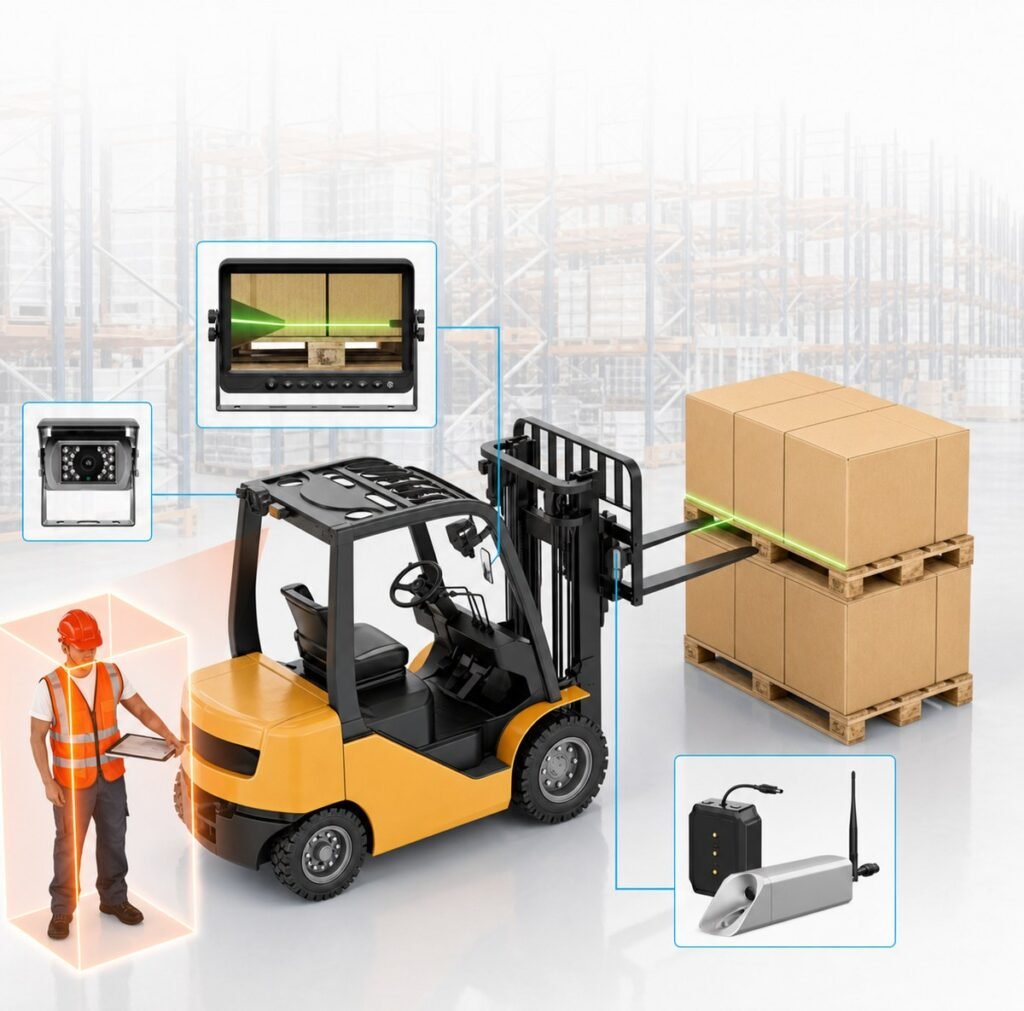
No single forklift camera system price accurately represents every warehouse or industrial vehicle project. A one-camera rear-view kit, a fork-positioning camera, a multi-camera split-screen system, and an AI pedestrian detection setup solve different visibility problems and use different hardware.
For B2B buyers, the useful question is not simply, “What is the cheapest forklift camera?” It is, “Which configuration covers the required viewing area, works in the operating environment, and includes the components needed for installation?”
This guide explains the main cost drivers so distributors, warehouse operators, integrators and forklift OEM buyers can compare quotations on the same basis.
Quick Answer
A forklift camera system quotation is mainly affected by camera type and quantity, monitor size and channels, wired or wireless transmission, power supply, AI detection, recording, environmental protection, installation accessories, order quantity and OEM customization.
Before comparing prices, confirm that each quotation includes the same camera coverage, monitor functions, power method, mounting hardware, cables or wireless components and after-sales scope. A low unit price can be misleading if key installation parts or required functions are excluded.
Start with the Visibility Problem
Different forklift tasks create different viewing requirements. The system should be configured around the operator’s actual problem rather than around a generic kit name.
- Rear blind-spot visibility when reversing in aisles or loading areas
- Fork and pallet alignment during stacking or retrieval
- Side-area visibility near racking, walls or pedestrian routes
- Pedestrian detection support in mixed-traffic warehouse zones
- Multi-view monitoring for larger forklifts or industrial vehicles
- Video recording when incident review or fleet management is required
These are typical application scenarios, not claims about a specific customer installation. For a broader system overview, see the Forklift Safety Camera Solution.
1. Camera Type and Viewing Purpose
A standard rear-view camera, fork camera and AI detection camera are not interchangeable.
A rear-view camera is selected to improve visibility behind the vehicle. A compact fork camera is positioned for pallet and fork alignment. An AI camera or AI monitor adds object classification and warning logic for selected pedestrian or vehicle detection applications. Each option changes the system architecture and quotation.
The lens angle, image format, low-light support, housing design and mounting position should match the application. Buyers should avoid comparing two camera quotations only by resolution.
2. Number of Cameras and Coverage Areas
A single-camera system is normally simpler than a two- or four-camera configuration. Additional cameras may require a monitor with more video inputs, split-screen display capability, more brackets or antennas, and different trigger logic.
Before requesting a quote, mark the required viewing areas on a forklift diagram. This helps the supplier recommend the correct camera count and reduces unnecessary components.
3. Monitor Size, Inputs and Display Functions
Monitor selection affects both price and usability. Compare screen size, camera inputs, split-screen display, trigger inputs, image mirroring, video-format compatibility and brightness. A larger screen is not automatically better. The display should fit the operator’s sightline without obstructing normal forklift operation.
4. Wired or Wireless Transmission
Wired systems use cable routing between the camera and monitor. Wireless systems reduce long signal-cable routing, but they still require careful planning for power supply, transmission distance, antenna position and possible interference.
The cost difference depends on the complete installation, not only the camera and monitor. A wireless system may include a battery, magnetic charger, transmitter, receiver or additional antennas. A wired system may require longer cables, protected routing and more installation labor.
See the wireless forklift camera system with monitor for a commercial product example, and review the forklift camera selection guide before deciding between wired and wireless configurations.
5. Camera Power, Battery and Charging Method
Power architecture is a major quotation variable for wireless forklift projects. Buyers should confirm available vehicle voltage, expected operating hours per shift, charging access, camera position, cable movement and spare-battery needs. Battery operating time should be evaluated against the real duty cycle, not assumed from a generic product photo.
6. AI Pedestrian Detection and Warning Functions
AI pedestrian detection can add another layer of operator awareness in selected warehouse zones. Depending on the system, the detection function may be processed by an AI camera, monitor or recorder, with visual or audible warnings.
This function changes the quotation because it requires compatible hardware and configuration. Buyers should ask what object types are detected, how the warning zone is set, where alerts are presented and what environmental limitations apply.
AI detection is an aid. It does not guarantee accident prevention and does not replace trained operators, traffic separation, worksite procedures or other required controls.
7. Recording and Storage
Some buyers need live viewing only. Others require video recording for incident review, training support or fleet management. Recording may involve an SD-card monitor or a separate mobile digital video recorder, depending on channel count, storage duration and system design.
Confirm the number of recorded channels, resolution, storage duration, event-trigger requirements, and whether local playback or remote fleet access is needed. Recording and remote connectivity should be quoted separately when they are not part of the base visibility system.
8. Environmental Protection and Installation Hardware
Forklift camera systems may operate indoors, outdoors, in cold storage, around dust, moisture, vibration or frequent washing. The required housing, connector protection and mounting method should reflect the worksite.
Where an IP rating is important, request the relevant product specification or test evidence for the exact camera model. Do not assume that every component in a system has the same environmental rating.
A complete quotation may also need brackets, magnetic mounts, antennas, extension cables, waterproof connectors, trigger wires, chargers, batteries and protected cable routing.
9. Order Quantity and OEM Requirements
A sample order and a fleet rollout have different cost structures. OEM or distributor projects may also require private labeling, custom cable lengths or connectors, packaging, manuals, monitor-menu languages, vehicle-specific brackets and sample approval.
These requirements should be stated before the final quotation. Changing them after sample approval can create avoidable rework.
Four Configuration Levels to Compare
| Configuration level | Typical components | Suitable buying question |
|---|---|---|
| Basic rear visibility | One rear-view camera and one monitor | Is the main need reversing visibility? |
| Fork positioning | Compact fork camera, monitor and optional guide reference | Does the operator need a clearer view of pallet entry and fork position? |
| Multi-view safety monitoring | Two to four cameras and a multi-input monitor | Which rear, side, fork or loading areas need simultaneous coverage? |
| AI and recording expansion | AI detection camera or monitor, alerts and optional recording | Is detection support or incident review required in addition to live viewing? |
This table is a configuration framework, not a fixed package list. Final component selection depends on the forklift, worksite and buyer requirements.
What to Include in a Forklift Camera RFQ
- Forklift type, model or clear vehicle photos
- Indoor, outdoor, cold-storage or other operating environment
- Main visibility problem and required camera positions
- Preferred monitor size and number of views
- Wired or wireless preference
- Available voltage and operating hours per shift
- AI pedestrian detection or warning requirement
- Recording and storage requirement
- Sample quantity and estimated batch quantity
- OEM logo, cable, connector, packaging or manual requirements
For blind-spot and mounting considerations, use the Forklift Blind Spot Camera System Guide.
Copy-Ready Forklift Camera RFQ Template
Use the same project brief for each supplier. Mark unknown details as “to be confirmed” instead of guessing.
Please quote a forklift camera system for:
- Forklift model(s), quantity per model, and installation photos:
- Main viewing task, camera positions, and monitor location:
- Required number of views, display layout, and switching behavior:
- Working environment, available power, and shift length:
- Battery operation, green laser, AI detection/alerts, or recording requested:
- Sample quantity and estimated rollout quantity:
- Destination country/postcode and requested delivery timing:
- OEM requirements or reference specification, if applicable:
Please identify the proposed camera and monitor models, included mounting and power accessories, separately priced options, and unresolved installation details. State the price basis, freight scope, lead time, payment terms, quotation validity, and warranty scope.
If our reference specification cannot be met, please identify the differences before sample approval.
Compare Total Project Cost, Not Only Unit Price
When reviewing quotations, check whether both include the same camera and monitor models, wireless components, battery and charger, mounting hardware, cables, storage, OEM work, freight terms, warranty and technical-support scope.
The lowest listed unit price is not always the lowest installed project cost. A complete component list makes the comparison more useful.
Check What Is Included Before Comparing Totals
A kit photograph does not confirm the supply scope. Ask for an itemized component list and separate optional accessories from included parts. Confirm whether freight, storage media, customization, and installation are included or excluded.
For a mixed fleet, request the proposed configuration for each vehicle group. Record the approved sample configuration so the production order can be checked against it.
Ready to request a quotation? Send your specification, photos, and quantity to Xinvisual Electronics.
Safety Context
OSHA guidance notes that blocked or partially blocked visibility increases accident risk and lists spotters, rear-view mirrors or other visibility aids among recommended practices. OSHA also requires appropriate operator training and evaluation under its powered industrial truck rules. The UK’s HSE guidance similarly treats visibility as part of lift-truck selection and safe use.
A camera system should therefore be treated as a visibility aid within a wider safety program. It should not be presented as a substitute for operator training, pedestrian controls, traffic planning, inspection or compliance with local requirements.
Frequently Asked Questions
Why is there no single forklift camera system price?
Because the required camera type, number of views, monitor, transmission method, power supply, AI functions, recording and installation accessories vary by project. A supplier needs the application details before preparing an accurate quotation.
Is a wireless forklift camera always more expensive than a wired system?
Not necessarily when installation is considered. Wireless hardware may add battery and transmission components, while wired systems may require more cable routing and installation labor. Compare the complete installed scope.
How many cameras does a forklift need?
The number depends on the visibility problem. A rear-view application may need one camera, while rear, side, fork and pedestrian-monitoring areas may require multiple cameras or separate functions.
Does AI pedestrian detection guarantee warehouse safety?
No. AI detection can support operator awareness, but performance depends on the system and environment. It does not replace trained operators, worksite controls or other safety procedures.
Can I request a sample before a fleet order?
Yes. A B2B sample can be used to evaluate image coverage, mounting, transmission, power and operator usability before batch planning. Confirm that sample and production specifications are aligned.
What is the fastest way to receive an accurate quotation?
Send forklift photos or model information, required viewing areas, environment, monitor preference, power information, quantity and any AI, recording or OEM requirements.
Request a Forklift Camera Configuration Review
Share your forklift type, worksite and required viewing areas so Xinvisual can recommend a suitable configuration before quotation.
Get a System Recommendation View Wireless Forklift Camera System