

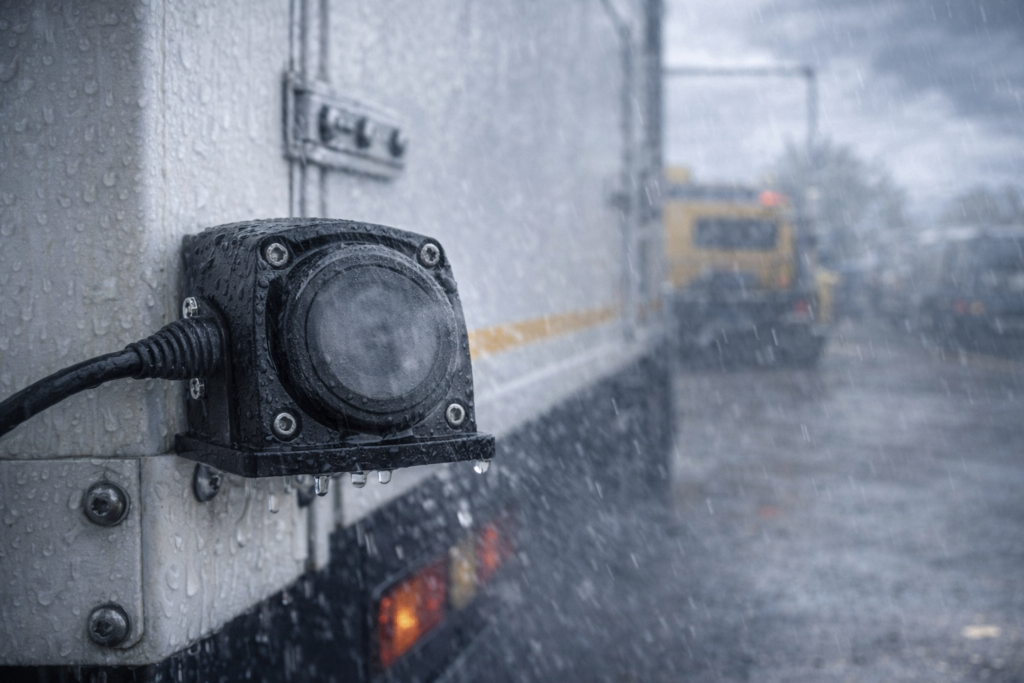
Internal fogging, surface moisture, and a white night image need different checks. Before replacing a vehicle camera, identify where the haze appears and record the conditions. A blurred screen image alone cannot establish that water has entered the housing.
This guide focuses on suspected moisture inside the camera and the questions buyers should ask before approving a replacement or a new sample. For haze that appears mainly in darkness, start with our backup camera white at night troubleshooting guide. For dirt or residue on the outside, see the vehicle camera lens cleaning checklist and follow the model’s cleaning instructions.
Cold weather brings several of these conditions together at once; our guide to keeping vehicle cameras usable in winter covers the seasonal checks for lenses, monitors, brackets and connectors.
1. What causes internal camera condensation?
Condensation forms when moist air encounters a surface cold enough for water vapor to become liquid droplets. Moisture inside an outdoor electronics enclosure can fog an optical surface when conditions change. Gore describes this general mechanism in its condensation management overview; it is not evidence of a particular Xinvisual camera’s construction or test performance.
Temperature changes can also change pressure inside an enclosure and stress its seals. However, pressure change alone does not establish the source of moisture or prove a design defect. A supplier needs to examine the affected unit, its installation, and the exposure history before assigning a cause.
2. What should you record before contacting the supplier?
With the vehicle parked safely, document the symptom before cleaning, opening, or replacing anything:
- Appearance: photograph the camera window from outside and capture the displayed image. Note whether droplets or haze appear to be on the outer surface or behind it; if you cannot tell, record that uncertainty.
- Timing: note whether the issue followed washing, rain, a temperature change, or extended storage, and whether it clears or returns.
- Installation: record the mounting position, cable route, connector condition, and any visible damage or recent work.
- Identity: provide the camera model, sample or batch reference if available, and the connected monitor or recorder.
These observations support investigation; they do not identify the failed component by themselves. Avoid opening the housing or improvising a heat or immersion treatment. Ask the supplier for model-specific handling instructions.
3. Which design details should buyers verify?
Housing seals and the complete cable path
Ask how the housing joints, optical window, cable entry, and connector assembly are protected in the supplied configuration. Confirm the required mating connector, installation instructions, and any maintenance limits. A housing rating should not be assumed to describe every extension cable or an unmated connector.
For an affected unit, ask the supplier to inspect these areas and explain the findings. Do not assume that seal material quality, cable moisture migration, or a particular component is responsible without inspection evidence.
Pressure equalization, if the model uses it
A suitable protective vent can help equalize enclosure pressure while resisting liquid-water entry under its specified conditions. It does not block all moisture: water vapor can pass through a breathable membrane in both directions. Vent selection and installation therefore matter, and a vent is not a guarantee of a condensation-free camera. See Gore’s protective vent FAQ for the general operating principle.
Ask whether the exact camera has a vent and request its applicable documentation. Do not infer a vent, nitrogen filling, potting method, or special sealing material from a product photograph, price, or an IP rating. This guide does not claim that these features are fitted to Xinvisual cameras.
Evidence for the exact sample configuration
Request the stated ingress-protection rating, applicable test standard and report, and the tested connector arrangement. Review any available temperature, humidity, or condensation evaluation separately. A rating or a single demonstration should not be presented as proof that a camera will remain fog-free in every installation.
4. Agree on a sample evaluation plan
Before exposing a sample to temperature changes or water, agree on a written procedure with the supplier or a qualified test laboratory. Include:
- the camera revision, cable assembly, connector state, and mounting arrangement;
- the power state, temperature and humidity conditions, transition method, duration, and number of cycles;
- when images will be captured and what counts as unacceptable obscuration, damage, or loss of function;
- the inspection method, acceptance criteria, and next step if the sample does not pass.
Do not choose heating temperatures or immediate ice-water immersion from a generic article. An operating-temperature range alone does not authorize that test procedure. Keep before-and-after records and distinguish an agreed sample evaluation from a verified field result.
5. Use the findings to guide the purchase
If the problem recurs, review the affected sample and installation with the supplier before selecting a replacement. Compare documented configurations and the agreed acceptance criteria, rather than choosing only by the highest advertised IP number.
When assessing project cost, include potential inspection, installation labor, replacement handling, and vehicle downtime. These are planning considerations, not measured Xinvisual customer outcomes or promised savings.
Frequently asked questions
Can an IP69K-rated vehicle camera still show internal fogging?
Do not interpret an ingress-protection label as a universal no-condensation guarantee. Check the report for the exact assembly and investigate the observed moisture, installation, and environmental conditions separately.
Does internal fogging prove that a seal has failed?
No. The symptom warrants investigation, but the image alone does not establish the moisture source or failure mechanism. Provide the supplier with the unit identity, photographs, and exposure history.
Should buyers test a heated camera in ice-cold water?
Only use a procedure approved for the specific sample by the supplier or qualified laboratory. This guide does not prescribe a universal thermal-shock or immersion test.
Discuss your vehicle camera requirements
Explore our vehicle camera range, or contact Xinvisual Electronics about your camera application. Tell us the vehicle type and mounting location; if you are reporting fogging, include the model and when it occurs. Photos and other project details can be provided during follow-up.