

What European Safety Regulations Mean for Commercial Vehicle Camera Systems
European safety rules are changing the way commercial vehicle buyers evaluate camera systems.
A vehicle camera used to be seen mainly as a reversing aid. Today, it is often part of a broader safety conversation: driver visibility, blind spot reduction, vulnerable road user protection, ADAS integration, and vehicle camera compliance.
For fleet managers, this means camera systems are no longer just optional accessories.
For OEM engineers, it means cameras, monitors, sensors, cables, and installation positions must be considered together.
For distributors and installers, it means customers are asking more technical questions before they buy.
This article explains what commercial vehicle safety regulations mean for B2B buyers of commercial vehicle camera systems, especially in European fleet, truck, bus, municipal, logistics, and retrofit applications.
Why Safety Regulations Are Changing Camera System Buying Decisions
European vehicle safety policy is moving toward better driver assistance, better detection, and better visibility around the vehicle.
The European Commission lists reversing detection with a camera or sensors, driver attention warning, intelligent speed assistance, event data recorders, cybersecurity, and emergency stop signals among mandatory advanced driver assistance systems for road vehicles such as cars, vans, trucks, and buses.
This does not mean every aftermarket camera automatically becomes a certified compliance system.
It does mean the market direction is clear: commercial vehicles are expected to help drivers see more, detect risk earlier, and reduce accidents involving pedestrians, cyclists, workers, and nearby vehicles.
For camera system buyers, the focus is shifting from:
“Can this camera show an image?”
to:
“Can this system help the driver manage a real safety risk?”
That is a very different buying standard.
From Reversing Cameras to System-Level Visibility
A simple reversing camera may still be useful, but many European projects now require a more complete visibility solution.
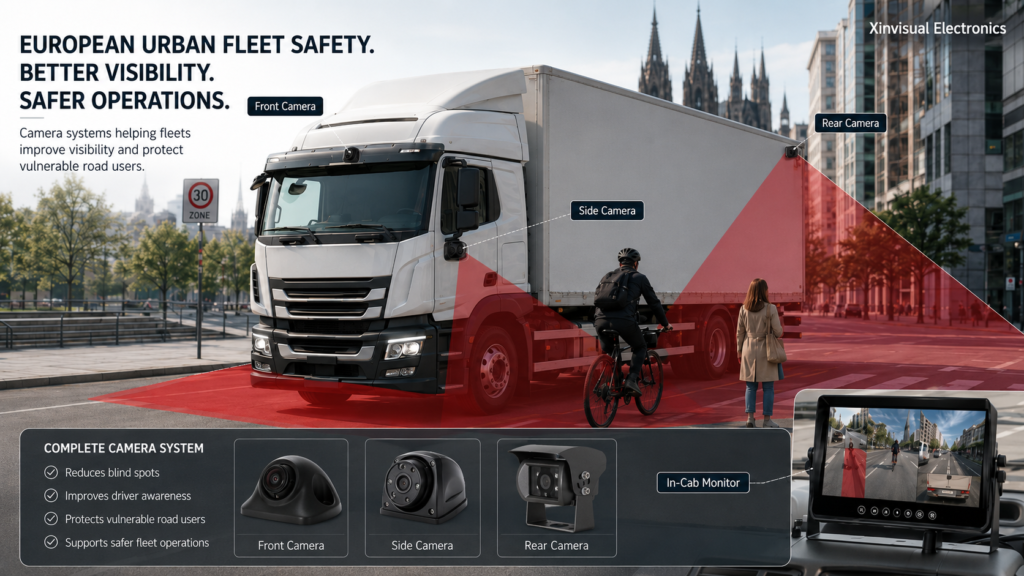
A modern camera system may include:
- Rear-view camera
- Side-view camera
- Front-view camera
- In-cab monitor
- Camera monitor system for trucks
- Blind spot detection sensor
- ADAS camera system
- Warning display or buzzer
- Vehicle-grade cables and connectors
- DVR or recording function
- Waterproof and vibration-resistant camera housing
For B2B buyers, the camera itself is only one part of the system.
A good solution also depends on:
- Where the camera is installed
- Whether the monitor supports the camera signal
- Whether the driver can see the display clearly
- Whether the system works in rain, snow, dust, vibration, and road salt
- Whether the installation supports the intended safety purpose
- Whether documentation is clear enough for distributors, installers, and fleet operators
This is why many commercial vehicle buyers are moving from individual camera selection to complete system configuration.
Key Regulation Areas B2B Buyers Should Understand
European regulations can be complex, and requirements vary by vehicle category, application, country, and approval route.
For most B2B buyers, it is not necessary to become a legal expert. But it is important to understand which regulation areas influence camera system demand.
General Safety Regulation and Reversing Detection
The EU General Safety Regulation has increased attention on advanced safety technologies in new vehicles. One area directly connected to camera systems is reversing detection.
For commercial vehicles, reversing is a common risk point in:
- Loading docks
- Warehouses
- Construction sites
- Urban delivery zones
- Bus depots
- Municipal service areas
- Logistics yards
A reversing detection solution may involve cameras, sensors, or a combination of both. The European Commission specifically refers to reversing detection with camera or sensors as part of the mandatory advanced driver assistance systems for road vehicles.
For buyers, this makes rear-view camera systems more than a convenience feature. They can support safer reversing, better driver awareness, and stronger fleet safety programs.
However, buyers should avoid assuming that any reversing camera automatically meets a specific regulatory requirement. For regulated applications, the vehicle category, installation method, field of view, approval status, and local rules must be checked.
Camera Monitor Systems and Indirect Vision
A camera monitor system for trucks becomes especially important when cameras are used as part of indirect vision.
UNECE Regulation No. 46 covers devices for indirect vision and the installation of these devices. It is relevant to mirrors, camera monitor systems, and indirect visibility solutions on vehicles.
For practical buying decisions, the key point is this:
There is a difference between an auxiliary camera and a certified camera monitor system used for required indirect vision.
An auxiliary camera may be installed to improve visibility, support reversing, help with side blind spots, or assist loading operations.
A certified camera monitor system may be required when the system is intended to replace a compulsory mirror or serve as an approved indirect vision device. Industry explanations of UNECE R46 note that only camera monitor systems with UN ECE Regulation 46 approval can be installed in place of a compulsory mirror.
This distinction matters for OEM engineers, distributors, and fleet buyers.
Before selecting a system, ask:
- Is the camera only an additional visibility aid?
- Is the system intended to replace a required mirror?
- Does the application require R46 approval?
- What field of view must be covered?
- Is the monitor position suitable for driver use?
- Are installation documents available?
This is one of the most important areas where product marketing must be accurate.
Direct Vision Standard and Urban Truck Safety
The Direct Vision Standard, often called DVS, is especially important for trucks operating in London.
Transport for London states that heavy goods vehicles need a safety permit before operating in most of Greater London. It also states that zero, one, and two-star rated HGVs need to install the Progressive Safe System.
For camera system buyers, DVS has had a strong influence on the market because it focuses attention on driver visibility and vulnerable road user protection.
TfL’s Progressive Safe System requirements include a Camera Monitoring System fitted to the nearside of the vehicle to help eliminate the remaining nearside blind spot. TfL also notes that a CMS can be used as an alternative to fitting Class V and VI mirrors.
This creates demand for:
- Nearside camera monitoring
- Side blind spot detection
- Moving-off safety support
- In-cab display systems
- Warning systems for vulnerable road users
- Retrofit kits for HGV fleets
- Installation support for distributors and service companies
For suppliers, the opportunity is not only selling a camera. The opportunity is helping customers configure a practical visibility solution for the vehicle and use case.
ADAS Camera Systems, Blind Spot Detection, and Driver Monitoring
Safety regulations are also pushing more attention toward ADAS-related technologies.
An ADAS camera system may support functions such as forward visibility, lane support, object detection, pedestrian detection, or integration with warning systems. In commercial vehicle applications, cameras are often used together with radar, ultrasonic sensors, AI algorithms, or driver alert interfaces.
A blind spot detection system for commercial vehicles may include:
- Side camera
- Radar or ultrasonic sensor
- AI pedestrian and cyclist detection
- Monitor display
- Audible warning
- Visual warning light
- Vehicle speed or turning signal logic
Driver monitoring is a related but different topic.
A driver monitoring system usually focuses on the driver inside the cab, such as fatigue, distraction, or attention warning. It can be relevant to broader safety regulation discussions, but it is not the same as an external vehicle camera system for blind spots or reversing.
For this reason, B2B buyers should define the application clearly:
- Do we need to see outside the vehicle?
- Do we need to detect cyclists or pedestrians?
- Do we need to monitor driver behavior?
- Do we need a camera, a sensor, or a combined system?
- Is the project for compliance, safety improvement, or operational visibility?
Clear system definition prevents wrong product selection.
What This Means for Fleet Managers
Fleet managers are often under pressure from safety requirements, driver complaints, maintenance costs, insurance risk, and vehicle downtime.
For them, commercial vehicle safety regulations affect purchasing decisions in several ways.
First, older vehicles may require retrofit safety upgrades to operate in certain areas or meet customer requirements.
Second, urban delivery trucks need better visibility around cyclists, pedestrians, and loading zones.
Third, vehicles working in logistics yards, depots, and construction areas need reliable reversing and blind spot visibility.
Fourth, camera failure can become more than a small maintenance issue if the camera is part of a safety process.
When selecting commercial vehicle camera systems, fleet managers should consider:
- Which vehicle types create the highest safety risk?
- Are the vehicles operating in regulated urban areas?
- Are reversing incidents common?
- Are drivers struggling with side blind spots?
- Is the system easy for drivers to use?
- Can the cameras survive rain, vibration, road salt, and washing?
- Is there installation support?
- Are spare parts and replacement cameras available?
The right camera system should reduce risk without creating unnecessary downtime.
What This Means for OEM Engineers
OEM engineers need to evaluate camera systems from a vehicle integration perspective.
For OEM and vehicle manufacturing projects, the questions are more technical:
- What vehicle category is involved?
- Is the camera for auxiliary visibility or approved indirect vision?
- Does the project require R46 consideration?
- What camera field of view is needed?
- Where will the monitor be installed?
- Does the monitor location affect driver ergonomics?
- What is the required voltage range?
- What signal format is needed: AHD, CVBS, digital, or other?
- What EMC, vibration, and temperature requirements apply?
- Does the system need to connect with ADAS modules?
- Are customized cables or connectors required?
For OEM projects, cameras and monitors should not be selected as separate parts. They should be defined as a complete vehicle-grade system.
This includes:
- Camera
- Monitor
- Cable
- Connector
- Bracket
- Power input
- Signal format
- Installation position
- Documentation
- Testing requirements
A technically correct configuration helps reduce integration problems later.
What This Means for Distributors and Installers
For European distributors and installers, safety regulation creates a stronger sales opportunity — but also a higher responsibility.
Customers may ask:
- Is this suitable for truck safety upgrades?
- Can it support DVS-related projects?
- Is it compatible with AHD or CVBS monitors?
- Can it work with existing vehicle wiring?
- Is it waterproof?
- Is it easy to install?
- Does it include a complete kit?
- What warranty support is available?
- Is it certified for mirror replacement?
Distributors should avoid vague product descriptions.
Instead of selling a product as only:
“Truck camera”
it is better to describe the system by application:
“Side-view camera and monitor system for improving driver visibility around commercial vehicles.”
or:
“Rear-view camera system for logistics trucks, buses, and heavy-duty vehicles.”
or:
“Blind spot camera solution for fleet safety retrofit projects.”
This makes the product easier for B2B customers to understand and easier for sales teams to explain.
Installers also need clear information:
- Wiring diagram
- Trigger wire instructions
- Monitor input type
- Camera signal format
- Bracket position
- Cable length
- Connector type
- Power range
- Recommended installation position
Good documentation reduces after-sales issues.
What This Means for Safety Officers
Safety officers are not usually focused on camera model numbers. They care about risk reduction.
For them, the important question is:
Does this system help prevent the type of accident we are trying to reduce?
A camera system may support safety goals in several situations:
- Truck turning near cyclists
- Reversing near loading docks
- Pedestrians walking near blind spots
- Municipal trucks operating in city streets
- Buses moving in crowded terminals
- Forklifts working around trucks and warehouse workers
- Heavy machinery operating in dusty or low-visibility areas
However, a camera system should not be treated as a replacement for safe driving procedures. It should support the overall safety process.
That includes:
- Driver training
- Correct installation
- Clear monitor position
- Regular maintenance
- Lens cleaning
- Cable inspection
- System testing
- Incident review
A strong safety program combines equipment, training, and daily operating discipline.
Application Scenarios in Europe
Logistics Trucks in Urban Delivery
Urban logistics trucks face complex visibility risks.
Drivers may deal with cyclists, pedestrians, narrow streets, parked vehicles, delivery bays, bus lanes, and frequent reversing. In this environment, a camera system can help reduce blind moments during low-speed maneuvers.
A suitable configuration may include:
- Nearside side camera
- Rear-view camera
- Front-view camera
- In-cab monitor
- Blind spot detection sensor
- Visual or audible warning
- Durable cable connection
For fleet managers, the goal is not only better images. The goal is safer driver decisions in real traffic.
Municipal and Utility Vehicles
Municipal vehicles often operate close to pedestrians and workers.
Examples include:
- Waste collection trucks
- Road maintenance vehicles
- Utility service trucks
- Street cleaning vehicles
- Snow removal vehicles
- Public works vehicles
These vehicles may stop frequently, reverse often, and operate in crowded urban areas.
For this type of application, commercial vehicle camera systems should focus on:
- Rear visibility
- Side blind spot coverage
- Low-speed maneuvering
- Night or early morning operation
- Waterproof protection
- Strong monitor mounting
- Stable power input
A rugged system can help reduce safety risk and maintenance problems.
Buses and Passenger Transport
Buses require reliable visibility around doors, sides, rear areas, and passenger zones.
Camera systems may support:
- Side monitoring
- Rear view
- Door area observation
- Depot movement
- Passenger safety
- Low-speed maneuvering
For buses, display clarity and driver ergonomics are especially important. The monitor should support safety without distracting the driver.
Forklifts and Warehouse Vehicles
While many road regulations focus on on-road vehicles, the same safety logic applies inside warehouses.
Forklifts often work around trucks, loading docks, workers, racks, and pallets. Blind spots may appear when:
- A tall pallet blocks the front view
- The forklift reverses near a dock
- The mast hides part of the view
- The vehicle turns in a narrow aisle
- Cold storage conditions reduce visibility
A forklift camera system can help with:
- Front-view visibility
- Rear-view monitoring
- Fork alignment
- Side blind spot awareness
- Cold storage operation
Heavy Machinery and Construction Vehicles
Construction trucks, agricultural vehicles, mining equipment, and heavy machinery operate in harsh conditions.
For these vehicles, camera system durability is critical.
Important features include:
- IP67 or IP69K waterproof camera housing
- Shock-resistant structure
- Vibration-resistant bracket
- Wide voltage input
- Sealed aviation connectors
- WDR for difficult lighting
- Night vision where required
- Strong cable protection
- Stable monitor mounting
In harsh environments, a low-cost camera may fail quickly even if the image looks acceptable at first.
For heavy-duty applications, long-term reliability is part of safety.
Product Selection Checklist for European Projects
Before selecting a camera system for European commercial vehicle projects, B2B buyers should review the following checklist.
1. Define the Safety Purpose
Ask:
- Is the system for reversing?
- Is it for side blind spot visibility?
- Is it for moving-off safety?
- Is it for driver assistance?
- Is it for auxiliary visibility?
- Is it for approved indirect vision?
- Is it for fleet safety improvement or regulatory compliance?
This step helps avoid choosing the wrong product.
2. Confirm the Vehicle Type
Different vehicles need different solutions.
Consider:
- Truck
- Bus
- Van
- Trailer
- Forklift
- Municipal vehicle
- Agricultural machine
- Construction equipment
- Special-purpose vehicle
A camera system for a city truck is not always suitable for a forklift or excavator.
3. Check Camera and Monitor Compatibility
Compatibility is one of the most common causes of installation problems.
Confirm:
- AHD, CVBS, or digital signal
- 720P or 1080P resolution
- PAL or NTSC format
- Number of monitor channels
- Split-screen support
- Trigger line function
- DVR requirement
- Connector type
- Cable length
- Power input range
A matched camera and monitor kit can reduce technical risk for distributors and installers.
4. Evaluate Durability
European fleets may operate in rain, snow, mud, road salt, washing, vibration, and long working hours.
Check:
- IP rating
- Operating temperature range
- Vibration resistance
- Shock resistance
- Lens protection
- Anti-fog design
- Hydrophobic coating
- Housing material
- Cable exit design
- Connector sealing
For outdoor commercial vehicles, waterproofing and connector quality are just as important as resolution.
5. Consider Real-World Image Quality
A camera should be evaluated under real operating conditions, not only in a catalog.
Important image features include:
- WDR
- Low-light performance
- IR night vision
- CMOS sensor quality
- Stable image response
- Good color contrast
- Low image delay
- Monitor brightness
- Anti-glare performance
For fleets, a clear and stable image helps the driver react faster.
6. Review Documentation and Support
For European B2B projects, documentation builds trust.
Useful materials include:
- Product datasheet
- Wiring diagram
- Installation guide
- Camera field-of-view information
- Monitor compatibility list
- IP rating information
- Warranty policy
- Packaging information
- Application notes
- Compliance statement where applicable
Good support helps distributors, installers, and fleet buyers reduce project risk.
Common Mistakes to Avoid
Mistake 1: Treating Every Camera as a Compliance Product
Not every vehicle camera is a certified compliance device.
Some cameras are excellent auxiliary visibility tools but may not meet approval requirements for regulated applications.
Use careful language:
Better:
“Designed to support visibility improvement and safety-oriented retrofit projects.”
Avoid:
“Fully compliant with all European safety regulations.”
Unless certificates and approval documents are available, do not make compliance claims.
Mistake 2: Ignoring Monitor Compatibility
A camera cannot work properly if the monitor does not support the same signal format.
For example, an AHD camera may not display correctly on a CVBS-only monitor.
Always confirm camera and monitor compatibility before ordering.
Mistake 3: Choosing Price Over Durability
Low-cost cameras may look attractive, but commercial vehicles operate in demanding conditions.
If the camera fails because of vibration, water ingress, cable damage, or connector problems, the total cost becomes higher.
For B2B buyers, stable performance matters more than the lowest unit price.
Mistake 4: Installing Cameras Without Defining the Blind Spot
A camera should solve a specific visibility problem.
Before installation, define:
- Which area is the driver unable to see?
- When does the risk happen?
- Which camera angle is needed?
- Where should the monitor be placed?
- Does the driver need automatic trigger switching?
Camera position should follow the risk area, not just the easiest mounting point.
How Xinvisual Electronics Supports Camera System Configuration
At xinvisual electronics, we provide vehicle cameras, vehicle monitors, roof-mounted monitors, forklift camera systems, and waterproof heavy-duty camera solutions for B2B applications.
For European safety-oriented projects, buyers often need more than a camera model. They need a suitable system configuration.
Our product categories can support:
- Rear-view camera systems
- Side-view camera systems
- Front-view camera applications
- Camera monitor systems for trucks
- Forklift camera systems
- IP69K waterproof vehicle cameras
- AHD and CVBS camera options
- Multi-channel vehicle monitors
- Fleet safety retrofit projects
- Distributor product programs
Depending on the project, a system can be configured with:
- Vehicle camera
- Vehicle monitor
- Extension cable
- Aviation connector
- Trigger wire
- Bracket
- Waterproof housing
- Night vision
- WDR
- Wide voltage input
- Multi-camera display
For regulated applications, buyers should confirm local approval requirements, installation rules, and certification needs before deployment.
Our role is to help customers choose practical camera and monitor configurations for real vehicle environments.
Conclusion
European commercial vehicle safety regulations are pushing the market toward better visibility, better detection, and better system-level thinking.
For camera system buyers, this creates a clear message:
A commercial vehicle camera is no longer just a simple accessory.
It can be part of a wider safety solution involving driver visibility, blind spot awareness, ADAS camera systems, monitor compatibility, and vehicle camera compliance planning.
For fleet managers, the right system can help reduce risk and downtime.
For OEM engineers, it can support better vehicle integration.
For distributors and installers, it creates a stronger product story.
For safety officers, it supports practical accident prevention.
The best starting point is not asking which camera is cheapest.
The better question is:
Which visibility risk are we trying to reduce, and what system configuration can solve it reliably?
Looking for a commercial vehicle camera system for European fleet, distributor, OEM, or retrofit projects?
Contact xinvisual electronics to discuss camera position, monitor compatibility, cable connection, waterproof requirements, and system configuration.
You can request a sample, ask for a quotation, or consult our engineering team for suitable camera and monitor options.
FAQ
Q1: Do European commercial vehicle safety regulations require camera systems?
European commercial vehicle safety regulations increasingly require or encourage technologies related to reversing detection, indirect vision, blind spot awareness, and driver assistance, depending on vehicle category and application. The exact requirement depends on the vehicle type, approval route, operating area, and whether the camera is auxiliary or part of an approved system.
Q2: What is the difference between a vehicle camera and a camera monitor system?
A vehicle camera usually provides additional visibility for reversing, side view, or operational monitoring, while a camera monitor system includes both camera and display as an integrated driver visibility solution. If the system is intended to replace a required mirror, approval requirements such as UNECE R46 may become relevant.
Q3: How does the Direct Vision Standard affect truck camera systems?
The Direct Vision Standard affects truck camera systems by increasing demand for better visibility around HGVs operating in London. Vehicles with lower star ratings may need additional safety equipment, such as camera monitoring systems, blind spot detection, and warning systems, to meet permit requirements.
Q4: What should B2B buyers check before choosing a camera system for European projects?
Buyers should check the vehicle type, safety purpose, camera signal format, monitor compatibility, field of view, IP rating, voltage range, connector type, installation position, documentation, and local approval requirements before choosing a camera system for European commercial vehicle projects.