

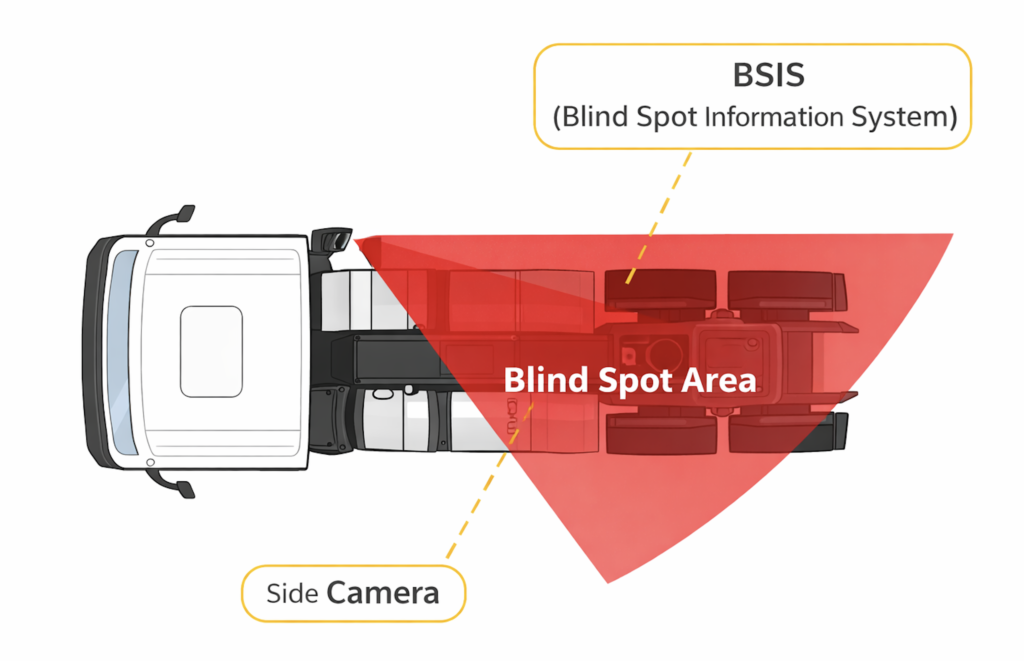
What Is BSIS and Why Are European Fleets Pivoting Toward It?
If you operate trucks, buses, or heavy-duty vehicles in Europe, you’ve likely noticed a shift in the conversation. Customers are no longer just asking for a “waterproof camera” or a “larger monitor”—they are asking for BSIS.
This shift represents a fundamental change in the industry: the market is moving away from basic hardware and toward integrated safety solutions designed to protect vulnerable road users and fit real-world fleet applications.
In this article, we break down what BSIS actually is, why it has become a priority in Europe, and what buyers are truly looking for.
What Exactly Is BSIS?
BSIS stands for Blind Spot Information System.
Unlike a simple mirror, BSIS is a functional system designed to alert drivers to the presence of pedestrians or cyclists (vulnerable road users) in the vehicle’s near-side blind spot. For heavy goods vehicles (HGVs), buses, and construction equipment, these blind spots are a critical safety failure point—especially along the side and around the front corners.
Why the Sudden Surge in Interest?
The focus on BSIS in Europe isn’t accidental. It is driven by three main factors:
-
Regulatory Mandates (UNECE R151): Under the EU General Safety Regulation (GSR), BSIS is now mandatory for new types of trucks and buses. Fleet operators are looking to stay compliant.
-
Urbanization & Safety: In dense European cities, heavy vehicles must coexist with a growing number of cyclists and scooters. Standard mirrors often fail to reveal these smaller, fast-moving targets during turns.
-
From “Products” to “Solutions”: Fleet buyers are becoming more sophisticated. They are moving past “commodity” cameras and seeking systems that actively reduce risk and lower insurance liabilities.
Is BSIS Just a Side Camera?
No—and this is a common misconception.
A standard side camera simply provides a video feed. BSIS is a safety function. While a camera is often the “eye” of the system, a true BSIS-related solution focuses on the utility of the information provided to the driver.
A practical, project-ready blind spot solution depends on:
-
Strategic Camera Placement: Eliminating the gap between direct vision and mirror vision.
-
Optimized Lens Angles: Reducing distortion while maximizing coverage.
-
Environmental Resilience: Reliable performance in heavy rain, high vibration, and low-light conditions.
-
Actionable Feedback: Ensuring the driver can interpret the monitor instantly during high-stress maneuvers.
Key Features Buyers Look For
When a professional buyer asks about BSIS, they are looking for reliability over specs. Here is what matters in the field:
| Feature | Why It Matters |
| Image Clarity | Drivers have split seconds to react. Grainy or lagging images are a liability. |
| Dynamic Range | The system must work in the “golden hour” (glare) and at night (low light). |
| Ruggedized Hardware | Commercial vehicles face power surges, dust, and pressure washing. |
| Ease of Integration | Installers need systems that are easy to mount and calibrate for different vehicle lengths. |
Which Vehicles Benefit Most?
While mandatory for many, BSIS-type solutions are being retrofitted across various sectors to minimize risk:
-
Logistics & Heavy Trucks: Especially for right-hand turns (in LHD countries).
-
Municipal & Refuse Trucks: Constant stopping and starting in high-pedestrian areas.
-
Construction Vehicles: Managing blind spots on uneven, high-traffic job sites.
-
Buses & Coaches: Protecting passengers and pedestrians at urban stops.
The Bottom Line
The market for commercial vehicle safety is maturing. The conversation is no longer about the size of the screen; it’s about the quality of the safety outcome. For suppliers and distributors, success means moving beyond selling a box of parts. It means providing a solution that addresses the real-world dangers of heavy vehicle operation. If your customers are asking for BSIS, they aren’t just looking for hardware—they are looking for peace of mind.
FAQ
Is BSIS the same as a side-view camera?
Not exactly. A camera is a component. BSIS is the functional system (often including sensors or AI) that provides information to the driver regarding blind spot risks.
Why is BSIS a “European” topic?
Because of strict EU safety regulations (GSR) and the high density of cyclists in European urban centers.
Do all BSIS systems require AI detection?
While the highest standard of BSIS (R151) requires the system to “inform” or “warn” the driver, many fleet owners start with high-quality camera-monitor systems to significantly improve visibility before moving to AI-based detection.
Can these systems be retrofitted?
Yes. Most modern camera-monitor solutions are designed to be retrofitted onto existing fleets to bring older vehicles up to modern safety standards.
Looking for a professional blind spot camera solution?
Contact Xinvisual Electronics today. We specialize in high-performance camera and monitor systems tailored for trucks, buses, and heavy-duty fleet projects.