

A camera mounted near hydraulic lines may receive oil splashes. A rear camera on a municipal sweeper may be washed with detergent every day. In both cases, a waterproof rating answers only part of the purchasing question.
Vehicle camera chemical resistance depends on the exposed materials, the chemical formulation, and the conditions of contact. Before approving a system, ask whether the available evidence covers the proposed camera, cable, and connector assembly in your application.
Does IP69K Mean a Camera Is Chemical-Resistant?
No. An ingress protection rating does not establish compatibility with hydraulic oil, grease, fuel, or cleaning agents.
ISO 20653 addresses enclosure protection for road-vehicle electrical equipment, including protection against water ingress. IP68 concerns immersion under specified conditions; the 9K water-protection designation concerns high-pressure cleaning. Neither establishes universal chemical resistance.
ISO 16750-5 addresses chemical loads on vehicle electrical and electronic equipment. It can inform project validation, but buyers must agree on the relevant chemicals and exposure conditions. Continuous chemical contact may require a separately agreed test approach.
Check the exact standard, designation, tested configuration, and report scope. A camera enclosure report should not automatically be treated as evidence for an extension cable or an exposed connector.
Start with the Application and Cleaning Routine
Typical exposure questions differ by installation:
- Construction and agricultural equipment: Could hydraulic fluid, fuel, or grease reach the camera or cable?
- Municipal sweepers and service vehicles: Which detergent is used, at what dilution, and how long does it remain before rinsing?
- Mining equipment: Are repeated washdowns combined with heat, vibration, or chemical residue?
- Trucks and trailers: Do connectors sit in road spray, collect runoff, or contact lubricants near articulation points?
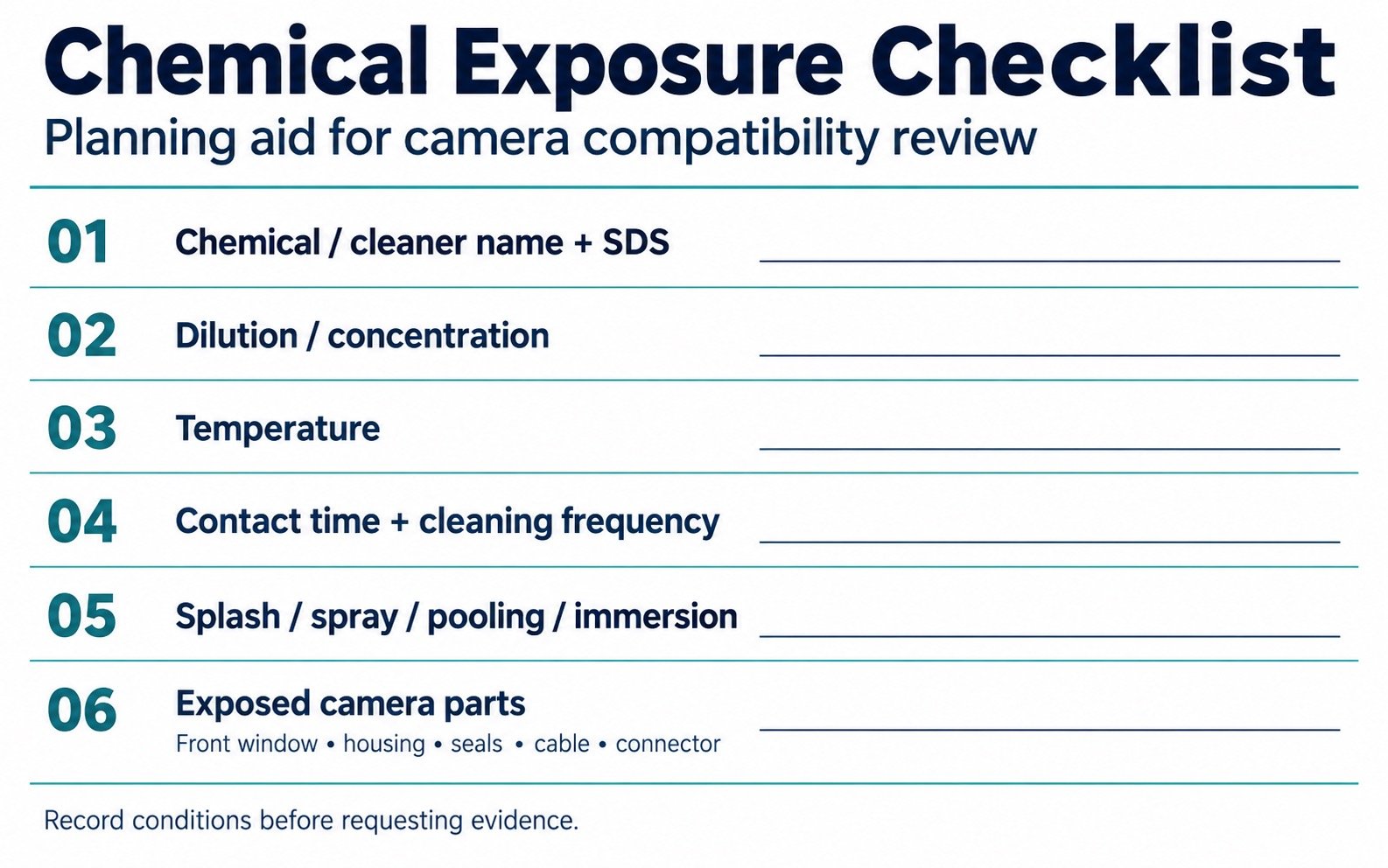
Provide the chemical product name and its safety data sheet when available. Include concentration, temperature, contact duration, cleaning frequency, and whether contact is a splash, spray, pooling, or immersion.
A description such as “oil-resistant” is too broad for approval. Even the same fluid viscosity grade can cover different formulations. Cleaner pH is useful information, but it does not describe the full formulation.
Check Each Exposed Component
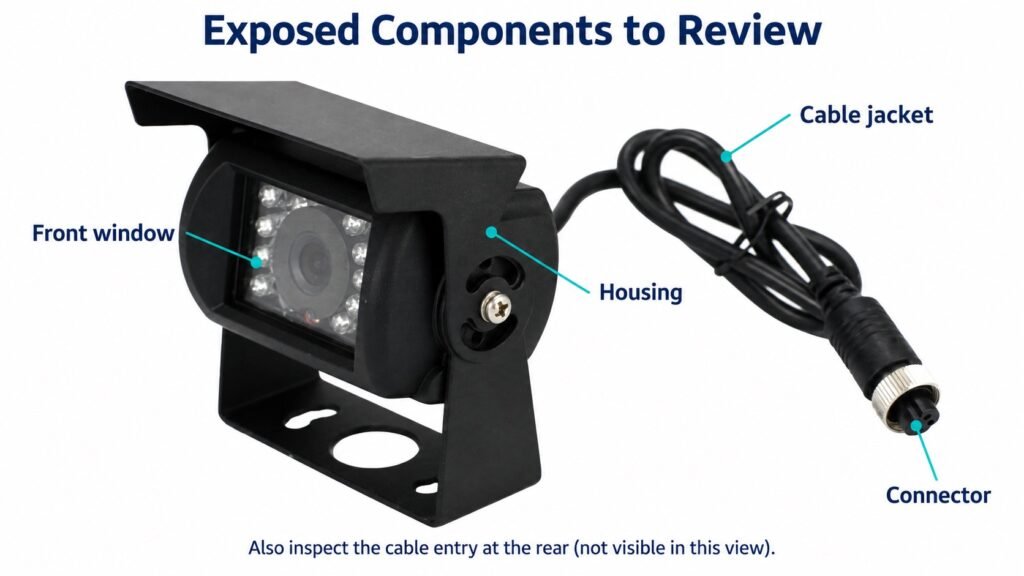
Front Window, Housing, and Coatings
Ask about the front-window material, surface treatments, housing finish, and bonding materials. Depending on the chemical and material, exposure may affect visibility, coatings, or adhesive joints.
A glass window does not establish compatibility of the adhesive around it. A corrosion report for a housing finish does not demonstrate resistance to a particular degreaser.
Seals, Cable Entry, and Strain Relief
Request the seal compound or available compatibility evidence. Generic descriptions such as “rubber seal” are insufficient for demanding applications.
Material families can help screen options, but performance varies with formulation, temperature, and exposure. Avoid selecting a seal solely because its generic material name appears on a compatibility chart.
Cable Jackets and Connectors
Review the supplied cable, extension cable, connector seals, and molded joints. A jacket described as PUR or PVC still needs evidence relevant to the proposed fluid and duty cycle.
Confirm whether connector protection applies when fully mated and correctly installed. Include cable movement and bending in the review if the installation is on a boom, mast, or trailer connection.
Turn the RFQ into a Verification Plan
Use a short matrix instead of a general request for a “chemical-proof camera.”
| Exposed part | Exposure to record | Evidence to request | Result to assess |
|---|---|---|---|
| Front window and bond | Cleaner, dilution, contact time | Relevant material and assembly data | Image clarity and bond condition |
| Housing and finish | Fluid, temperature, frequency | Finish-specific exposure evidence | Coating and surface condition |
| Seals and cable entry | Splash, pooling, or repeated cleaning | Compound data and assembled-joint testing | Seal condition and ingress performance |
| Cable and connectors | Fluid contact plus bending or vibration | Exact cable and connector evidence | Jacket condition and electrical function |
Agree on acceptance criteria before testing. Do not copy arbitrary swelling limits, test durations, or hardness thresholds into a purchase specification.
Raw-material data is useful for screening. Finished-assembly testing provides additional evidence about joints, seals, coatings, and function after exposure. Neither should be described as covering conditions outside the documented scope.
Buyer Checklist Before Sample Approval
- Identify the exact camera, cable, and connector configuration.
- Record chemicals, dilution, temperature, and contact conditions.
- Separate documented performance from items awaiting validation.
- Agree on inspection, functional checks, and acceptance criteria.
- Consider routing or shielding to reduce direct exposure.
- Record approved cleaning instructions and installation restrictions.
Use controlled sample evaluation before field deployment where compatibility remains uncertain. A field trial can supplement testing, but its findings apply to the conditions actually observed.
FAQ
Can I clean an IP69K camera with an engine degreaser?
Only if compatibility with that product and cleaning procedure is confirmed for the specific assembly. The IP rating alone is insufficient.
Is an oil-resistant cable enough for the whole system?
No. The camera seals, cable entry, connector, and other exposed parts need their own review. Cable evidence does not establish complete-system compatibility.
Which component usually fails first?
There is no universal answer. It depends on the materials, exposure, and installation. Inspect the optical surface, coating, seals, cable entry, jacket, and connectors.
Request a Project Compatibility Review
Selecting cameras for an installation exposed to oils, grease, or repeated cleaning? Send Xinvisual Electronics your mounting location, chemical product details, cleaning routine, and required camera-and-cable configuration.
Our team can review the proposed hardware and clarify available specifications, supporting documentation, and items requiring further validation before sample approval.
Reference links: