

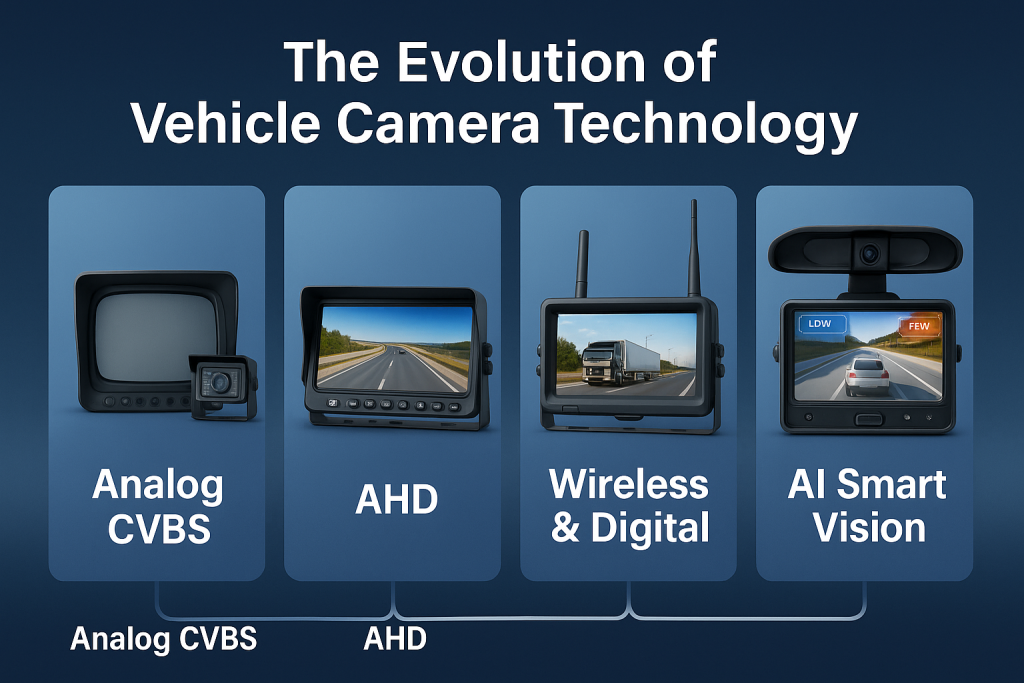
Vehicle camera technology has moved from simple analog reversing cameras to high-definition AHD cameras, waterproof commercial vehicle cameras, wireless camera systems, AI blind spot detection cameras and MDVR recording systems. For fleet buyers and OEM engineers, the important point is not the technology name alone, but how each technology solves a real vehicle visibility or safety problem.
This guide explains the main technology stages used in commercial vehicle camera systems and how to match them with trucks, buses, forklifts, trailers, vans and industrial vehicles.
Quick Answer
Modern commercial vehicle camera systems usually combine AHD video, waterproof camera housings, vehicle monitors, optional wireless transmission, AI detection and MDVR recording. A basic reversing system may only need one camera and one monitor, while a fleet safety system may require multiple cameras, recording, blind spot monitoring and customized installation support.
From Analog Cameras to AHD Vehicle Cameras
Analog vehicle cameras were widely used for basic rear view and reversing applications. They were simple, affordable and easy to install, but image quality was limited compared with newer AHD systems.
AHD vehicle cameras provide clearer video for truck, bus, trailer and industrial vehicle monitoring. For drivers, a clearer image can make it easier to understand distance, road conditions and nearby obstacles. For buyers, AHD also provides a practical upgrade path without always requiring a fully digital video system.
Why Waterproof Ratings Matter for Commercial Vehicles
Commercial vehicle cameras often work outdoors, near dust, rain, vibration, road spray and wash-down environments. This is why waterproof housing design is important. Depending on the application, buyers may compare IP67, IP68 and IP69K camera options.
For construction vehicles, buses, trucks and forklifts, the camera housing, connector and cable design should be selected according to the real working environment. A waterproof camera is only reliable when the complete installation is also suitable.
Vehicle Monitors and Display Products
A vehicle camera needs a suitable display. Commercial vehicle monitors may be installed on the dashboard, inside the cab, on the roof area of a passenger vehicle or as part of an electronic mirror monitoring system. Monitor size, mounting position, brightness and input compatibility all affect the user experience.
Xinvisual supplies vehicle monitors, roof-mounted monitors and mirror monitor products for different commercial vehicle and passenger transport applications.
Wireless Camera Systems for Retrofit Projects
Wireless camera systems are useful when cable routing is difficult, especially on trailers, forklifts and retrofit vehicle projects. A wireless system can reduce installation time, but buyers still need to confirm transmission distance, antenna position, interference environment and power supply.
For warehouse vehicles, a wireless system may be paired with rear view, fork view or pedestrian awareness applications. See Xinvisual’s Forklift Safety Camera Solution and Wireless Camera Systems.
AI Blind Spot Detection Cameras
AI blind spot detection cameras add target detection capability to vehicle monitoring. Depending on configuration, the camera can support pedestrian, cyclist or vehicle awareness within the monitored area. This makes the camera a safety system component rather than only a viewing device.
AI BSD cameras are commonly discussed for trucks, buses, fleet retrofit projects, forklifts and industrial vehicles. For compliance-sensitive projects, describe these products as BSIS/MOIS-style application components or blind spot detection components unless a complete certified system has been confirmed.
MDVR Recording and Fleet Review
MDVR systems allow fleets to record video from multiple vehicle cameras. This is useful for incident review, driver behavior review, fleet safety management and multi-camera monitoring. A fleet may combine front, rear, side and interior cameras with an AHD 1080P MDVR system.
Recommended Technology by Application
| Application | Recommended technology | Typical Xinvisual path |
| Truck reversing | AHD rear camera + monitor | AHD Reversing Camera |
| Forklift retrofit | Wireless camera + compact monitor | Wireless Camera Systems |
| Side blind spot monitoring | AI BSD camera + monitor | BSD AI Camera |
| Fleet recording | Multi-camera system + MDVR | Fleet Camera Monitoring Solution |
| Passenger transport display | Roof-mounted monitor or display product | Roof-mounted Monitors |
Buyer Checklist
- Vehicle type and application environment
- Camera position: rear, side, front, fork view or interior
- Required image format and monitor compatibility
- Waterproof and vibration requirements
- Wired or wireless transmission
- Need for AI detection or standard viewing only
- Need for MDVR recording
- Cable length, connector type and power supply
- OEM/ODM customization requirements
How Xinvisual Supports Vehicle Camera Projects
Xinvisual Electronics manufactures vehicle cameras, monitors, wireless camera systems, AI blind spot detection cameras, MDVR systems and vehicle display products for distributors, OEM projects and commercial vehicle applications. The right system should be selected based on vehicle type, installation position and the buyer’s safety or monitoring goal.
For project selection, visit Vehicle Cameras, Vehicle Monitors, AI Blind Spot Detection Camera Solution or contact Xinvisual for a system recommendation.
FAQ
What is the difference between analog and AHD vehicle cameras?
Analog cameras provide basic video for reversing or monitoring. AHD vehicle cameras provide higher-definition video and are commonly used in modern commercial vehicle camera systems.
When should a fleet use a wireless vehicle camera system?
Wireless camera systems are useful for trailers, forklifts and retrofit projects where cable routing is difficult. Transmission distance and interference conditions should be checked before ordering.
Do all vehicle camera systems need AI detection?
No. Standard cameras are suitable for many viewing applications. AI detection is useful when the project needs blind spot awareness, pedestrian detection support or warning output.
When is MDVR recording recommended?
MDVR recording is recommended when a fleet needs multi-camera video recording, incident review or centralized fleet safety review.