

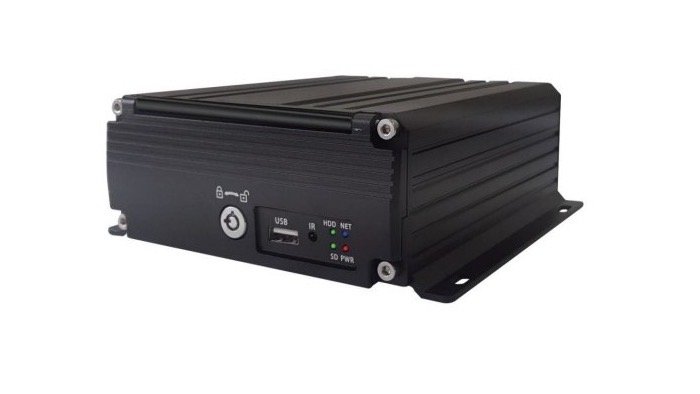
Choosing between a 4-channel and an 8-channel mobile DVR should begin with the areas the vehicle must record, not with a preference for the larger number. Four channels can be sufficient when four defined camera positions cover the operational requirement. Eight channels become relevant when the project needs more interior, exterior, door, work-area, or equipment views, or when a controlled expansion plan is part of the vehicle specification.
Channel count also affects the rest of the system. More active cameras can change storage retention, review time, harness complexity, connector count, camera power planning, and installation documentation. An 8-channel recorder is not automatically a better system, and a 4-channel recorder is not automatically the simpler choice if the project later adds unplanned cameras.
This guide uses available Xinvisual product specifications for a related 4/8-channel MDVR platform. It explains how buyers can size the system and approve a sample without treating optional functions, storage duration, camera compatibility, or external requirements as automatic.
Start with a Camera Position Map
List every view before selecting the recorder. On a vehicle drawing, assign a purpose to each camera: front, rear, left, right, driver, passenger, door, cargo, equipment, or another work zone. Record whether each view must be continuous, local, event-reviewed, or remote, and whether it is required now or belongs to an approved future option.
A fleet camera monitoring solution may include cameras, a recorder, connectivity, and a review platform, but those parts still need an exact bill of materials. The channel map is the first document that connects the operational requirement to that bill of materials.
Typical Application Scenarios
Delivery Trucks and Service Vehicles
A typical four-view layout may use front, rear, left-side, and right-side cameras. A 4-channel mobile DVR can fit when those positions satisfy the requirement and no cabin, cargo, or equipment view is planned. The sample must still confirm format, routing, image direction, and playback.
Buses, Coaches, and Passenger Vehicles
A passenger vehicle may need exterior views plus door, aisle, passenger, or driver recording. When the approved list exceeds four cameras, an 8-channel mobile DVR can keep the views in one recorder. This is a typical scenario, not a Xinvisual customer case or a rule for every bus.
Refuse, Construction, and Utility Vehicles
These vehicles can have rear equipment, lifting mechanisms, side work zones, or changing body positions. Plan around the actual equipment envelope; a compact cab can still require more than four views.
Standardized Fleet Platforms
A fleet or OEM may use one recorder architecture across several body variants. Standardization only works when unused ports, harness branches, settings, and later camera additions are documented in the approved design.
Available Xinvisual 4/8-Channel Platform Facts
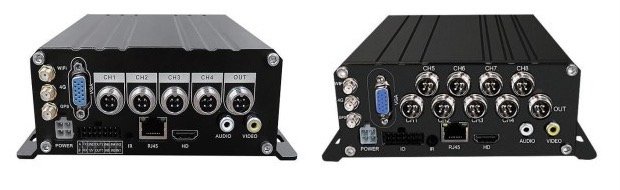
The reviewed Xinvisual specification covers related 4-channel and 8-channel versions. Public component names are generalized here; exact model mapping remains in the private Product Fact Check.
| Decision Area | Available Specification | Buyer Interpretation |
|---|---|---|
| Video inputs | 4 or 8 channels, up to 1080P and backward compatible | Choose from the approved camera map; confirm the exact signal on every channel |
| Compression and recording | H.264; 1080P, 720P, or D1 recording resolution; adjustable frame rate and quality | Resolution and quality settings affect retention and must be approved with channel count |
| Playback | 4-channel or 8-channel synchronous playback by version | Confirm how the reviewer will locate and compare several views after an event |
| Storage | Up to 1 TB SD card and up to 4 TB hard disk | Maximum capacity is shared platform information, not a fixed retention promise |
| Video outputs | One HDMI, one VGA, and two CVBS outputs in the available specification | Select the local display and service workflow before finalizing output connections |
| Alarm I/O | The sheet lists 4/6 alarm-input groups, notes six for the 8-channel version, and lists optional eight-input support; two alarm outputs are listed | Exact I/O quantity and behavior must be confirmed for the ordered configuration |
| Power input | DC8V-36V; automatic shutdown protection is listed above 42V | Recorder input range does not establish camera or accessory power compatibility |
| Optional connectivity | 4G, WiFi, GPS/BD or GLONASS, and RJ45 functions are listed as modules or options | Add each required function to the RFQ; do not assume it is included |
The source also lists PAL/NTSC-related support, mixed 1080P, 960P, 720P, TVI, and CVBS input, channel-level image adjustment, and automatic trigger display. Evaluate these functions on the exact sample because camera type, settings, trigger logic, and ordered modules affect the workflow.
Technical Considerations That Change with Channel Count
1. Camera Coverage Comes Before Spare Capacity
Choose four channels when four mapped views meet the requirement and there is no validated fifth camera. Choose eight for five to eight defined views or an approved camera option package. Unused inputs without a harness, mounting plan, and camera specification are not an expansion strategy.
2. Storage Retention Must Be Recalculated
Retention depends on active channels, resolution, quality, frame rate, schedule, and storage. Eight active channels at comparable settings require a different retention calculation than four. Define the minimum review window, overwrite rules, and export process, then measure the sample. The MDVR product category can support product comparison.
3. Review Workflow Can Become the Bottleneck
The specification lists synchronous playback for four or eight channels by version. Confirm how files are searched, which views appear together, whether timestamps align as required, who exports footage, and how files are retained.
4. Power Must Be Designed for the Whole Camera Set
The recorder is listed for DC8V-36V input and provides listed +12V and +5V outputs. This does not prove every camera, monitor, router, or alarm can be powered together. Calculate exact loads, confirm pin assignments, define protection and grounding, and test representative operating states.
5. Alarm Inputs Are Not the Same as Camera Inputs
Video channels and alarm inputs are different. Alarm inputs can receive door, turn, brake, or reverse signals when supported. Confirm the ordered I/O count, input type, trigger priority, display and recording response, and return behavior.
6. Optional Connectivity Must Be Ordered Explicitly
The source lists 4G, WiFi, positioning, and RJ45 as modules or options. An eight-camera recorder does not automatically include remote monitoring, GPS, or network access. State each requirement, platform expectation, antenna plan, and data workflow in the RFQ.
7. Harness and Service Work Increase with More Cameras
Eight routes can create more connectors, entry points, labels, and maintenance checks than four. Document connector type, cable length, strain relief, sealing, moving sections, and replacement access. The vehicle camera category supports camera selection, but compatibility still depends on signal, power, connector, and image requirements.
Selection Guidance: When Four or Eight Channels Make Sense
Choose a 4-channel mobile DVR when:
- the approved system has no more than four camera positions;
- those views cover the operational and review requirement;
- there is no confirmed expansion package beyond four cameras;
- the harness and maintenance plan are controlled around four channels.
Choose an 8-channel mobile DVR when:
- the approved camera map requires five to eight views;
- passenger, door, cargo, equipment, or additional exterior views are part of the project;
- several body variants will use a documented common recorder platform;
- storage, review, power, I/O, and harness plans have been recalculated for the larger system.
The 1080P 4G hard disk MDVR system is the relevant Xinvisual product reference for a shared 4/8-channel platform. Use its public page for product discovery and this guide for the channel-count decision.
Common Buyer Mistakes
Selecting by Vehicle Size Alone
A large truck may need only four approved views, while a compact service vehicle with several work zones may need more. Count the visibility and recording tasks, not the meters of vehicle length.
Treating Eight Channels as a Future-Proof System by Itself
Unused inputs are not an expansion plan. Future cameras also need mounting positions, cables, power, connectors, storage, software settings, and acceptance tests.
Assuming More Channels Include More Storage
The reviewed 4/8-channel platform lists the same maximum SD and hard-disk capacities. More active channels can reduce retention at comparable recording settings.
Confusing Alarm Inputs with Camera Inputs
Video channels and I/O signals serve different purposes. Confirm both counts and the intended trigger behavior.
Treating Optional Modules as Standard
4G, WiFi, positioning, and RJ45 functions must be confirmed in the ordered configuration. A feature mentioned for the platform is not automatically included in every unit.
Skipping the Multi-Channel Playback Test
A recording system is only useful when the fleet can find, compare, export, and retain the required views. Include the review workflow in sample approval. For related failure checks, see Xinvisual’s guide to why vehicle DVR systems lose recordings.
Sample Approval Plan
Bench-test the exact recorder, cameras, storage, harness, display, antennas, and modules. Confirm channels, signal, recording profile, time, image direction, triggers, alarms, playback, export, and overwrite behavior. On a representative vehicle, test coverage, connectors, cable movement, grounding, power transitions, display, and review. Record the channel map, ports, settings, storage profile, I/O, modules, cable lengths, and bill of materials. Different body or camera packages may need separate approval.
Buyer Checklist
- Vehicle type, body variant, and operating task recorded
- Every required camera view mapped and named
- Required-now and planned-later cameras separated
- 4-channel or 8-channel version selected from the approved map
- Camera signal, resolution, PAL/NTSC setting, and image direction matched
- Recording resolution, quality, frame rate, and schedule defined
- Retention target tested with the active channel count
- Synchronous playback and export workflow approved
- SD card and hard-disk requirements recorded
- Recorder input power and peripheral loads calculated separately
- Alarm-input count, input type, priority, and response confirmed
- 4G, WiFi, positioning, and RJ45 requirements ordered explicitly
- Antennas, SIM or network responsibilities, and platform expectations documented
- Camera connectors, port assignments, and cable routes labeled
- Installed sample photos, settings, and bill of materials retained
FAQ
Is an 8-channel mobile DVR always better than a 4-channel recorder?
No. The correct version is the one that supports the approved camera map and review workflow. Eight channels add input capacity, but they can also increase storage demand, wiring, review work, and configuration requirements.
Can a 4-channel MDVR record front, rear, left, and right cameras?
A four-input recorder can support four camera positions when the exact cameras, signal formats, connectors, power plan, and settings are compatible. Approve the installed views rather than relying on the position names alone.
Does an 8-channel MDVR keep footage for less time?
Retention depends on the number of active channels and the approved resolution, quality, frame rate, schedule, and storage capacity. With comparable per-channel settings and the same storage capacity, adding active channels changes the retention calculation. Measure the selected configuration.
Are 4G, WiFi, and GPS included with both versions?
Do not assume so. The available Xinvisual platform information lists connectivity and positioning as modules or options. Confirm each required function, antenna, platform, and market-specific configuration in the quotation and sample record.
Review the Configuration Before Sample Approval
Need help confirming the right recorder, cameras, monitor, cables, and connectors for your vehicle?
Send Xinvisual the vehicle type, camera positions, number of channels, power voltage, preferred monitor size, recording and retention requirements, cable lengths, connector preference, local or remote review workflow, alarm inputs, and connectivity needs. The team can review the proposed 4-channel or 8-channel configuration and identify the items that still need confirmation before sample approval.